
SB 743 Agency Decision Matrix
This guide helps California agencies make informed decisions on how to measure and assess Vehicle Miles Traveled (VMT) for land use and transportation projects, ensuring compliance with SB 743.

This guide helps California agencies make informed decisions on how to measure and assess Vehicle Miles Traveled (VMT) for land use and transportation projects, ensuring compliance with SB 743.
State-of-the-practice analytical methods should be employed when estimating the trip generation of mixed-use projects. In the latest issue of the American Planning Association’s PAS Memo, John Gard and Corwin Bell of Fehr & Peers describe the advantages, analysis techniques, and use of MXD+ through actual site case studies.

This white paper outlines how our MXD modeling tool was recalibrated and validated with recent travel data and conditions.
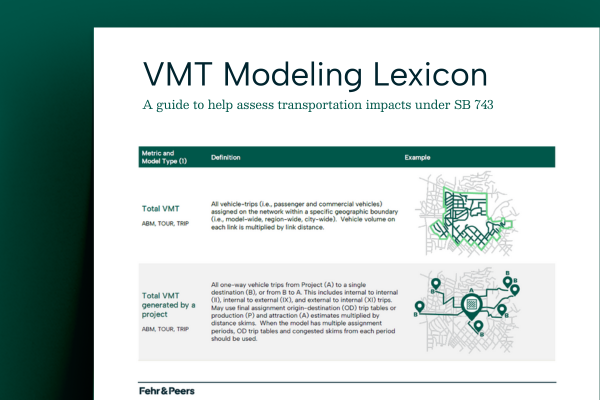
CEQA’s July 1 deadline is swiftly approaching, making it increasingly important to be able to understand and navigate all types of VMT calculations. Our new quick-reference VMT lexicon makes that easier. Explore it now here.

On September 27, 2013, Governor Jerry Brown signed SB 743 into law and started a process intended to fundamentally change transportation impact analysis as part of CEQA compliance. These changes include elimination of auto delay, level of service (LOS), and other similar measures of vehicular capacity or traffic congestion as a basis for determining significant impacts. Instead, transportation impacts will be determined based on changes to vehicle miles of travel (VMT).
Although there is much uncertainty regarding how autonomous vehicles (AVs) might transform cities and influence roadway safety, our recent ITE Journal article “Safeguarding Safety for Road Users Now While Planning for an Automated Future” published alongside the Eno Center for Transportation explores different safety strategies that are important to consider both today and in an AV future.