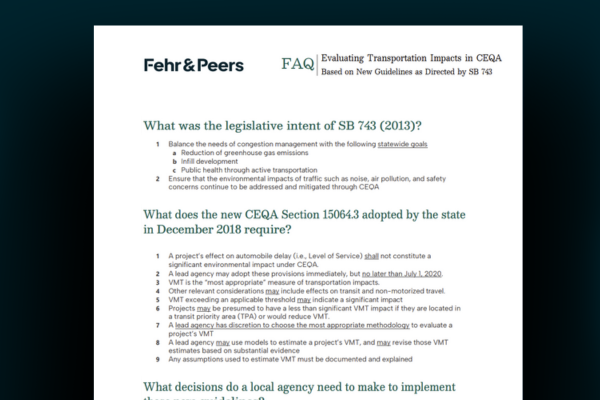
SB 743 and VMT FAQs
A guide for agencies on implementing SB 743’s requirement to assess transportation impacts based on VMT instead of traffic delay, aligning with California’s environmental objectives.

A guide for agencies on implementing SB 743’s requirement to assess transportation impacts based on VMT instead of traffic delay, aligning with California’s environmental objectives.
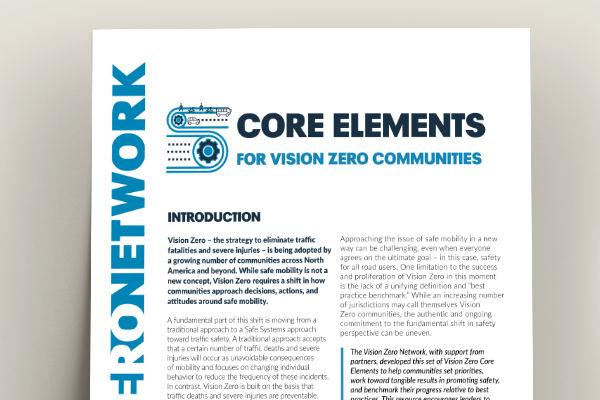
Vision Zero emphasizes a Safe Systems approach, which acknowledges that people make mistakes, and focuses on influencing system-wide practices, policies, and designs to lessen the severity of crashes.
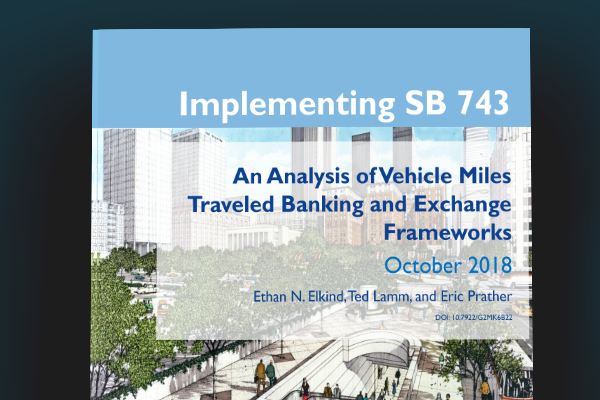
This report by Berkeley Law explores how California communities can use Vehicle Miles Traveled (VMT) banking and exchange programs to meet environmental goals under SB 743.
This document provides guidance for implementing California’s SB 743 in the Western Riverside County area, focusing on using Vehicle Miles Traveled (VMT) as a key metric in transportation impact analysis.
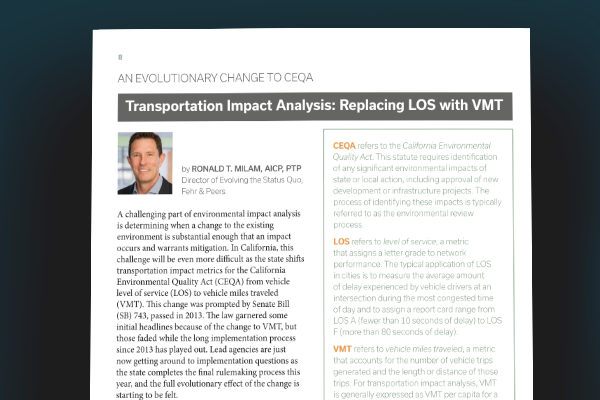
This article discusses California’s shift from using Level of Service (LOS) to Vehicle Miles Traveled (VMT) for evaluating transportation impacts under the California Environmental Quality Act (CEQA), highlighting the implications of Senate Bill 743 (SB 743) for local agencies.
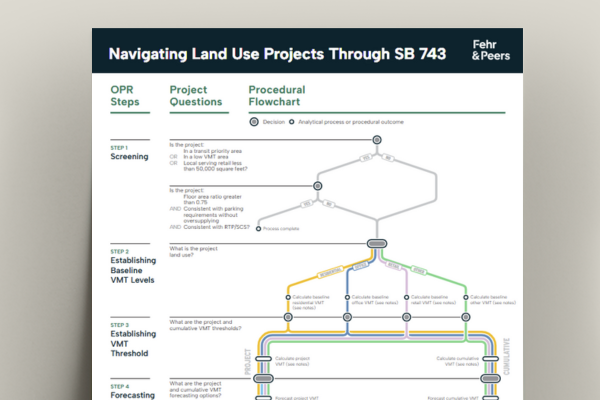
This document offers a step-by-step framework for evaluating and mitigating VMT impacts of land use projects under California’s SB 743 guidelines.