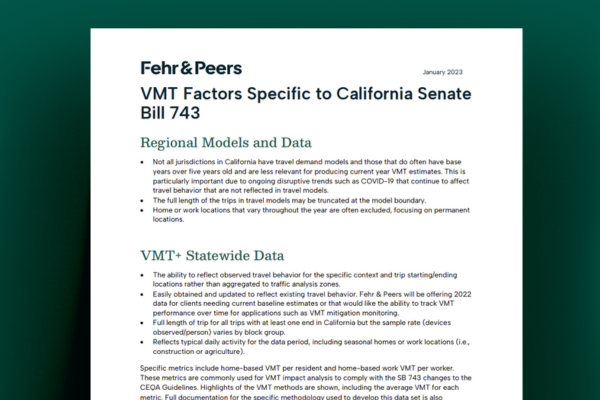
VMT Factors Specific to California Senate Bill 743
Traditional traffic models often miss current travel patterns. Our new method uses recent data to better estimate how much people drive, helping with SB 743 compliance.

Traditional traffic models often miss current travel patterns. Our new method uses recent data to better estimate how much people drive, helping with SB 743 compliance.
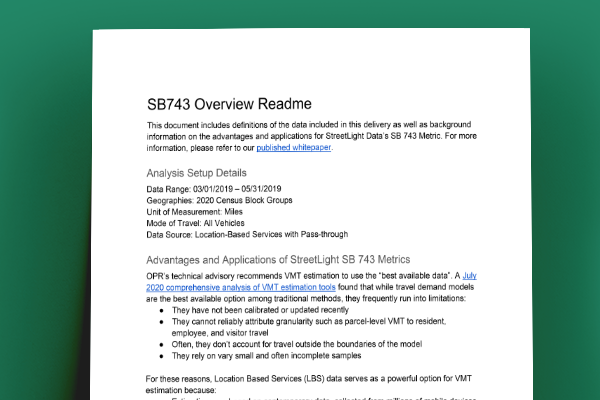
This overview details the advantages of using location-based services (LBS) data over traditional travel demand models, outlines the methodology for calculating VMT, and offers definitions for key metrics segmented by trip purpose and residence classification.
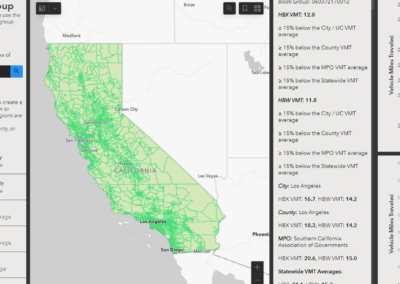
Our new VMT+ Tool provides a combination of resources to visualize VMT per capita at the Census Block Group level throughout California.
Explore ITE’s new technical brief that describes a comprehensive way for public agencies to incorporate the Safe System approach in project reviews, to build proactive, multimodal safety considerations into transportation impact analysis reports.
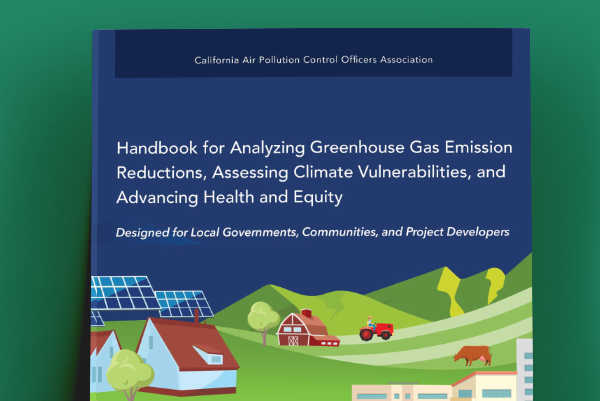
We are excited to share the release of an update to the CAPCOA Quantifying Greenhouse Gas Mitigation Measures. Over the past decade, practitioners have relied heavily on this key reference document for developing VMT and emissions mitigation measures.
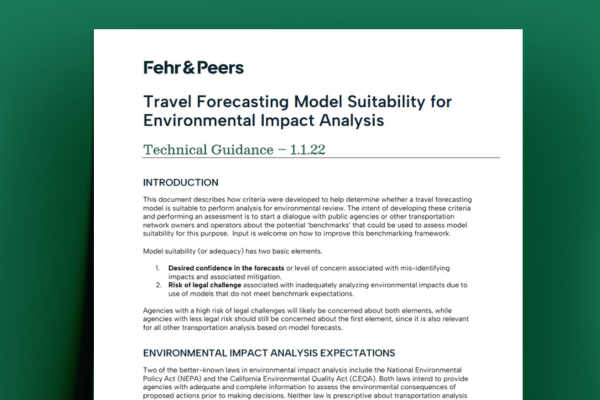
This guide helps transportation professionals determine if their travel forecasting models are suitable for environmental impact analyses, ensuring compliance with laws like NEPA and CEQA.