

Are project site TDM mitigation strategies reliable?
Since implementation of SB 743 in 2020, lead agencies using VMT have had questions emerge about VMT mitigation. One of these questions asks about the reliability of project site transportation demand management (TDM) mitigation strategies, such as those contained in Quantifying Greenhouse Gas Mitigation Measures (CAPCOA, 2021). The simple answer is that the effectiveness of these strategies depends on the performance of building tenants that can change over time. Ensuring effectiveness requires ongoing monitoring and strategy adjustment.

What is the concept of VMT mitigation banks and exchanges?
This answer has led to growing interest in program-based approaches to mitigation that can improve mitigation certainty. In 2019, U.C. Berkeley released a white paper describing the new concept of VMT mitigation banks and exchanges. Fehr & Peers, in collaboration with WRCOG, recently released a complement to the U.C. Berkeley paper that directly compares VMT mitigation banks and exchanges to traditional impact fee programs for deeper understanding. Further, the new white paper also contains specifics on potential legal requirements, and outlines the creation and implementation steps for each type of program with procedural flow charts. Program examples and implementation risks are also provided, making the paper an information-rich source for lead agencies seeking to successfully navigate the complexity of VMT mitigation strategies. Read the full white paper below.

share this article
Explore More

Help Shape a Generative AI Policy Starter Kit for Transportation Organizations
We’re developing a Generative AI Policy Starter Kit with ITE’s AI Great Ideas Group. If you’re creating AI guidance now, share one question or sample policy snippet to help shape the resource.
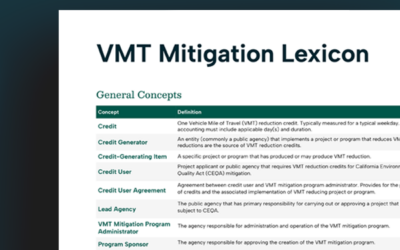
VMT Mitigation Lexicon
If you’ve ever paused mid-CEQA draft to ask “what do we mean by this, exactly?”, our new VMT Mitigation Lexicon is for you.

What Is Downtown DC For?
The DC decongestion pricing study landed years late in a city that looks nothing like the one it studied. What is the debate really about?