
New NCHRP Toolkit Helps Agencies Build Safety Into Everyday Decisions
Safety work often happens one project at a time: a signal retimed here, a crosswalk repainted there, each one justified by whatever crash came before it. Meanwhile, capital budgets, design standards, and development review usually sit with different teams, run on different funding cycles, and respond to different priorities. When those upstream pieces don’t work together, progress made on one project can unintentionally be undone by a decision made somewhere else.
With our subconsultant partners VHB and Horizon 54, we recently led the development of NCHRP Research Report 1181, Toolkit for Institutionalizing the Safe System Approach, through NCHRP Project 08-171. The toolkit includes 30 tools, each with several case studies showing what institutionalization looks like in practice, organized across four themes: building institutional commitment, updating policies and budgets, revising design standards, and integrating land use. Together, they make it easier for safety to become part of how an agency already works, not a program bolted on top.
For readers who want to go deeper, the full research behind the toolkit, including literature review, agency interviews, and case study analysis, is documented in NCHRP Web-Only Document 451.
New IIHS Safe System Success Stories Released
A second collection of Safe System “Success Stories” was released last week at ITE International in Detroit. The Insurance Institute for Highway Safety (IIHS) led this effort in partnership with the University of North Carolina Highway Safety Research Center, the Institute of Transportation Engineers, the Vision Zero Network, and SafeTREC at UC Berkeley. We’re proud to support the work as a co-sponsor and co-author.
Several of the featured projects are what we call safety multipliers. Rather than focusing on a single factor, they address multiple Safe System levers, including exposure, severity, and likelihood.
Click through three examples below.
A city rewrote its budget around safety.
Santa Rosa built Safe System priorities into its capital improvement program, street design standards, speed management, and development review, with added focus on its High-Injury Network.
Pavement maintenance funding now comes with safety requirements. New walking and biking projects must also show a realistic path to construction, not simply appear on a long-range list. Before making permanent changes, the city tests lower-cost treatments through pilots and hands-on community events.

One redesign reduced crashes by a third.
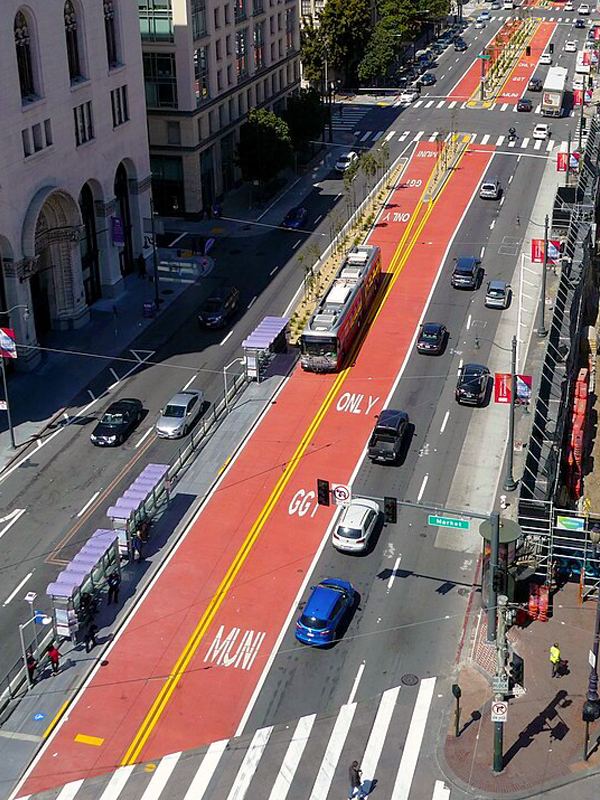
Transit-only lanes on Van Ness Avenue reduced overall collisions by 33% and transit-involved collisions by 82%.
The redesign reduced exposure, lowered speeds, and simplified conflicts at the same time. Transit ridership also returned to 103% of pre-pandemic levels, compared with 70% systemwide. The dedicated lane created a clear path for emergency vehicles, helping build support among first responders.

The state changed how projects are evaluated.
Environmental review once rewarded projects that eased congestion, even when they encouraged wider roads and longer trips. Since 2020, Senate Bill 743 has shifted the focus toward reducing driving overall.
That change works alongside housing laws that support more homes in walkable, transit-oriented places. Together, these policies can reduce the miles people travel and the opportunities for serious crashes to occur.
share this article
Connect with our Contributors

Meghan Mitman
Principal
AICP, RSP2I
Email Me

Kelly Bond
Senior Transportation Planner
Email Me

Erin Ferguson
Principal
PE, RSP2I
Email Me


Explore More

Marissa Aho Joins Fehr & Peers
As climate risk reshapes transportation planning, public agencies need strategies that connect resilience with everyday investment decisions. Marissa Aho, FAICP, brings decades of experience helping cities and regions turn climate risk into practical, fundable actions. Learn how her leadership expands our climate adaptation and resilience practice and strengthens the support we provide to communities.

2026 Staff Promotions
Join us in congratulating the 167 team members who earned promotions for their outstanding contributions this year.
Driving Less Starts with Building Differently
How much can planning decisions actually reduce driving? Our latest research introduces a statistical model that links built environment choices—such as density, transit service, walkability, and land use mix—to vehicle miles traveled (VMT). The findings give planners and policymakers practical, evidence-based tools to evaluate scenarios, understand tradeoffs, and make more informed transportation and land use decisions.