
Safety Multipliers: Decisions that Reduce Exposure, Severity, & Likelihood

When One Project Pulls All Three Levers
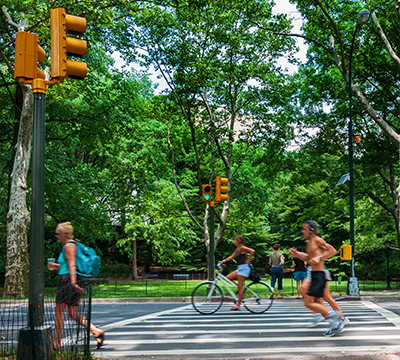
Most road safety projects are built around a single idea. A speed table slows cars down. A new marked crosswalk increases road users’ awareness to potential conflicts. A mixed-use development means fewer vehicle trips. Each of those is a real safety gain, and each one matters.
People jogging and cycling through a crosswalk
But the projects that move the needle on serious injury, the ones that contribute to sustained progress toward eliminating deaths and serious injuries from traffic collisions, usually do something different. They pull more than one lever at once, and the components reinforce each other.
aerial of mixed use development

We call these safety multipliers: packages of interventions that work together to reduce kinetic-energy risk across exposure, severity, and likelihood at the same time.

The multiplier effect is the part that gets missed. A transit-only lane does not just shift car trips to transit. The same design choice narrows the travel way for general traffic, which slows the cars that remain. It removes weaving and merging, which reduces conflicts. It gives emergency responders a clear route, which builds political support for the next project. One intervention, multiple levers moving in the same direction. That is the multiplier effect.

When One Project Pulls All Three Levers

Most road safety projects are built around a single idea. A speed table slows cars down. A new marked crosswalk increases road users’ awareness to potential conflicts. A mixed-use development means fewer vehicle trips. Each of those is a real safety gain, and each one matters.
People jogging and cycling through a crosswalk
But the projects that move the needle on serious injury, the ones that contribute to sustained progress toward eliminating deaths and serious injuries from traffic collisions, usually do something different. They pull more than one lever at once, and the components reinforce each other.
aerial of mixed use development

We call these safety multipliers: packages of interventions that work together to reduce kinetic-energy risk across exposure, severity, and likelihood at the same time.

The multiplier effect is the part that gets missed. A transit-only lane does not just shift car trips to transit. The same design choice narrows the travel way for general traffic, which slows the cars that remain. It removes weaving and merging, which reduces conflicts. It gives emergency responders a clear route, which builds political support for the next project. One intervention, multiple levers moving in the same direction. That is the multiplier effect.

Three Levers, Working Together

Exposure

How often and how far people travel by vehicle, how many vehicles share a given space, and how exposed other roadway users are to vehicles in that space. Fewer and shorter trips mean fewer chances for crashes to happen at all.

Severity

How fast and how heavy vehicles are when a crash happens. Speed dominates; kinetic energy scales with the square of speed, so a 20% speed reduction cuts crash energy by nearly 40%. A 5-mph increase in vehicle speed (from 25 mph to 30 mph) doubles the fatality risk for people walking and biking.

Likelihood

How often road users’ paths of travel cross or occupy the same space at the same time. Separating users in space and time, or removing the movements that create conflicts, lowers the chance that a crash occurs.
Every injury in a roadway crash traces back to kinetic energy exceeding the human body’s tolerance. The Safe System Approach identifies three places for us to intervene: exposure, severity, and likelihood.

A safety multiplier targets all three levers. The components are chosen so that each one reinforces the others: lower vehicle volumes reduce opportunities for conflicts and broaden the tools available for speed management, slower speeds make conflicts less lethal, and fewer conflicts reduce the moments when exposure and severity combine.
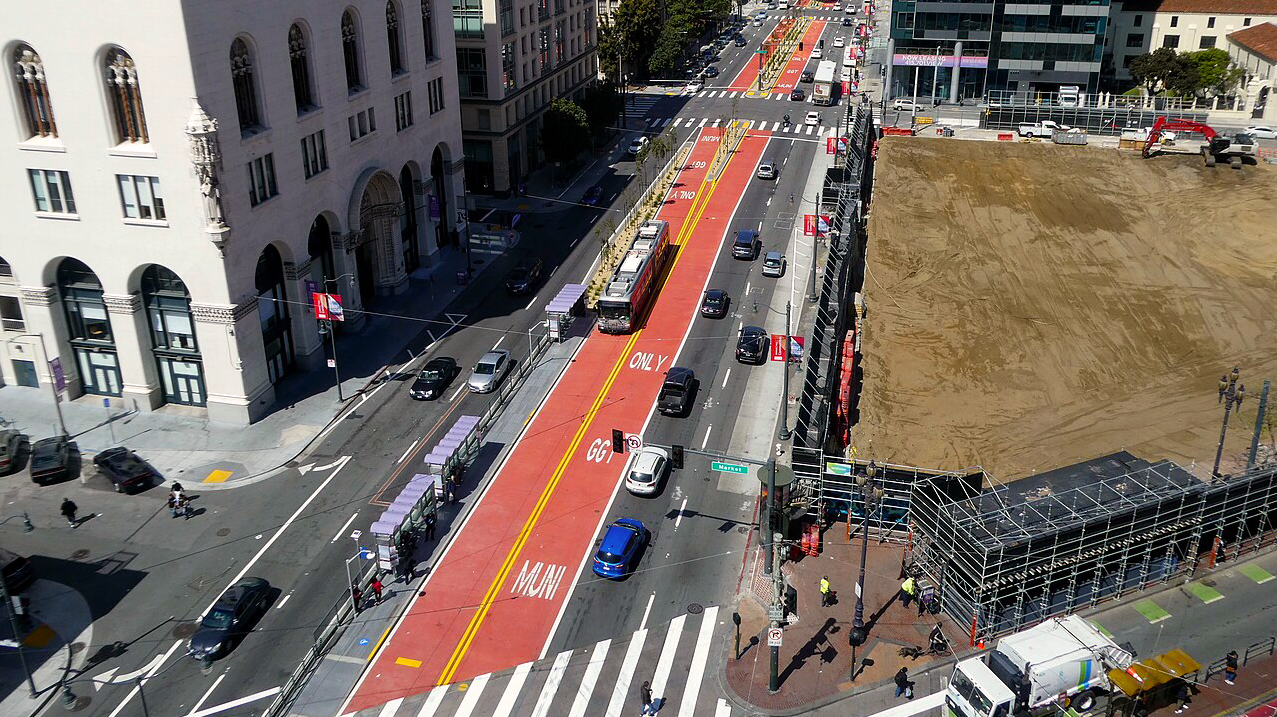
Aerial photo of San Francisco’s Van Ness Improvement Project
photo credit: Pi.1415926535, CC BY-SA 4.0 , via Wikimedia Commons.
The Van Ness Improvement Project in San Francisco, CA shows a great example of the multiplier effect.

Van Ness Avenue: The Multiplier in Action

San Francisco’s Van Ness Improvement Project is a great example of the multiplier effect. The corridor was on the city’s High-Injury Network with three wide general-purpose lanes per direction, buses stuck in mixed flow, permissive left turns, and frequent pedestrian crossings.
The redesign created center-running bus rapid transit lanes, dropped the general-purpose lanes from three to two, narrowed the remaining lanes, restricted left turns at most intersections, added median pedestrian refuges, and gave pedestrians a head start at signals.
What happened is what the multiplier framework predicts:

%

reduction in total crashes

%

reduction in transit-involved crashes

Transit ridership returned to

%

of pre-pandemic levels, well ahead of system-wide recovery at 70%

Emergency response

improved

because the transit lane doubles as an unobstructed access lane.

No single one of those changes produced those numbers. The package did. Each component made the others work even better. The full project documentation, including detailed before-and-after data, is available to download from SFMTA.

Putting the Multipliers to Work in Your Community

The multiplier framing can change how decision makers look at a project list and enhance/prioritize interventions. A few principles we have found useful:

Sequence the levers.

Reduce exposure first (fewer vehicles), then manage severity (survivable speeds), then address conflict (separation). Each layer compounds the one before it. A protected bike lane works better on a street that has already shed a lane and slowed down.

Treat routine projects as safety opportunities.

Resurfacing schedules, signal replacements, and development reviews each touch the right-of-way and can activate one or more levers at marginal additional cost. Reviewing a project list through the multiplier lens often surfaces low-cost additions to work that is already funded.

Measure leading indicators.

Operating speeds, near-miss rates, and mode share are better proxies for kinetic-energy risk than crash counts, and they show up sooner. They allow agencies to evaluate progress before harm accumulates.

Name all the wins.

Every safety multiplier advances goals beyond safety: transit reliability, emergency response, climate, economic vitality. Naming the co-benefits builds broader coalitions and unlocks more funding streams. The emergency-access argument ”win win” may be the one that helps move a project through political review.
The point of the multipliers framing is not to mechanize the decision. It is to make sure the design conversation starts with all three levers on the table—instead of one.

Safety Multipliers at a Glance

The table below catalogs twelve multipliers we have seen across our own recent Safe System research and project work, with the lever each one emphasizes.

Not every multiplier fits every street. The Movement and Place “design up or design down” prompt offers a useful sort: place-focused corridors tend to benefit most from pricing, transit-oriented development, and low-stress intersection packages; transition corridors from access management, BRT, roundabouts, and protected bikeways; movement-focused corridors from intelligent speed assistance, access control, speed safety cameras, and dynamic lane management.

= moderate effect   •• = strong effect   ••• = primary lever

Multiplier What it is Exposure Severity Likelihood
The Bus Lane Flip Right-of-way reallocation to transit-only lanes with restricted turns, narrowed general-purpose lanes, and transit signal priority ••• •• •••
The Road Diet Combo Lane reduction + protected bikeways + access management (raised medians, RIRO, roundabouts) •• ••• •••
The Pay to Shift Congestion pricing to reduce vehicle volumes and reinvest revenue in transit, active modes, and safe street design ••• •• ••
The Slow Wave Safe Waves signal timing: short cycles, low progression speeds, pedestrian recall ••• ••
The Crossing Cluster Frequent enhanced midblock crossings + bus stop access upgrades + Safe Waves signal timing •• •••
The Curb Shift Dynamic curbside management: delivery windows, priced loading zones, micro-hubs •• •• ••
The Safety in Abundance CIP audit and revamp: fund only projects that address all three levers •• •• ••
The Proximity Play Transit-oriented development and affordable housing near jobs, paired with VMT-based impact analysis ••• ••
The Tech Stack Vehicle technology: alcohol interlock + intelligent speed assistance + automatic emergency braking •• ••• ••
The Parking Pivot Remove parking minimums, price supply, unbundle parking from housing ••
The School Zone System Safe Routes to School connected networks: 15-20 MPH target speeds with proactive traffic calming, protected paths and crossings, bike buses, School Street closures •• •• ••
The Signal Reset LPIs + no-turn-on-red + protected left turns + centerline hardening, deployed at scale as a coordinated package •• •••
Deeper dives available at: Unified Framework for Safe System Implementation (Mitman et al., 2026, TRR forthcoming); the W’s of Safety framework (Mitman, Zhao & Engel, Transportation Research Record, 2025); and Safe Waves: Signal Timing Guide, Analysis Tool, and Case Studies (Furth et al., MassDOT, 2024).

Look for more information and multipliers case studies in the IIHS Safe System case study compendium to be released at the ITE International Conference in Detroit and in the NCHRP 08-171 Safe System Institutionalization Toolkit, releasing in June.

Let’s Connect

Have questions? We’re here to help.

Headshot for Meghan Mitman

Meghan Mitman

Principal

AICP, RSP2I

Email Me

headshot of Erin Ferguson

Erin Ferguson

Principal

PE, RSP2I

Email Me

Headshot of Hallet Modi

Hallet Modi

Principal

Email Me

Headshot of Luana Broshears

Luana Broshears

Associate

PhD, PE, PTOE, RSP2I

Email Me

Headshot of Rebecca Sanders

Rebecca Sanders

Principal

PhD, RSP2B

Email Me
