
The City That Knows How to Say Yes
We work with cities navigating some of the hardest questions in transportation. Not just how to move people or manage public space, but how and when to make decisions that serve everyone.
Authored by: Eric Womeldorff, Principal and Transportation Economics Practice Leader, Fehr & Peers Washington, DC
The City That Knows How to Say Yes
Every city learns how to say no.
That’s not because leaders are unimaginative or indifferent to progress. It is because no is often the safest answer in a system that punishes mistakes more than missed opportunities. And thus, no becomes clean. No becomes easy. No can sound like prudence, equity, safety, community input, or respect for process. Sometimes it is all those things. Cities should say no to unsafe streets, no to bad actors, no to companies that want to privatize the upside and have the costs borne by the public.
But a city that only knows how to say no is not prudent. It is brittle. We all know what can happen to brittle things.
The harder task is knowing how to say yes.
Not yes to everything. And not yes to every new thing. Not yes because technology is magic, or because the private sector always knows best, or because the future has a lobbyist on K Street. That view is convenient and could be dangerous. But there is another kind of yes—conditional, measured, and public-minded. Yes, if you meet clear standards. Yes, if you pay for the costs you create or impose. Yes, if you improve safety. Yes, if you strengthen access. Yes, if you serve the whole city. Yes, if you can prove the public is better off.
A city is a machine for turning private claims and desires into public order and opportunity. That definition is far less romantic than simply saying cities are about “community,” but it is closer to the truth. Every sidewalk, every park bench, every travel lane can become a venue for an argument about who gets to do what, where, when, and at whose expense. Thankfully, they’re also potential venues for living out community and seeing each other.
That is why cities are always tempted by no.
Autonomous vehicles (AVs) are a good test of whether cities still know how to do this. But they are only one example. The same question appears in fights over housing, bus lanes, safer streets, energy infrastructure, outdoor dining, and half the things cities say they want until someone tries to build them. The common thread is not technology. It is whether a community can govern change without treating the status quo as sacred.
Because the status quo is never as innocent as it looks. This is one of the great evasions in public life. The new thing often must justify every risk and uncertainty. The current thing simply exists. Human driving, for example, is not asked to reapply for permission to operate on our streets every year. It does not have to prove that it will not kill anyone. It just shows up, year after year, and demands the presumption of legitimacy.
And yet the current system produces crashes, injuries, deaths, noise, blocked crosswalks, and a level of antisocial behavior that we have somehow learned to call normal. Anyone who moves around a city knows the little civic bargain we make every day: the car nosed into the crosswalk, the bus stuck behind a UPS truck with its flashers on, the driver treating a red light like a suggestion. This does not mean AVs are automatically safer. It does mean the burden of proof should not be assigned as if only the new thing creates risk. The current thing creates risk too. The corollary is that inaction is privileged over action.
Government exists to protect people from having someone else’s freedom imposed on them. Someone’s freedom to move around the city does not include a right to endanger others or make the public realm worse because they got there first. Rules are not the enemy of freedom. Properly designed, rules are the thing that makes freedom possible among people who do not want to live alone in the woods.
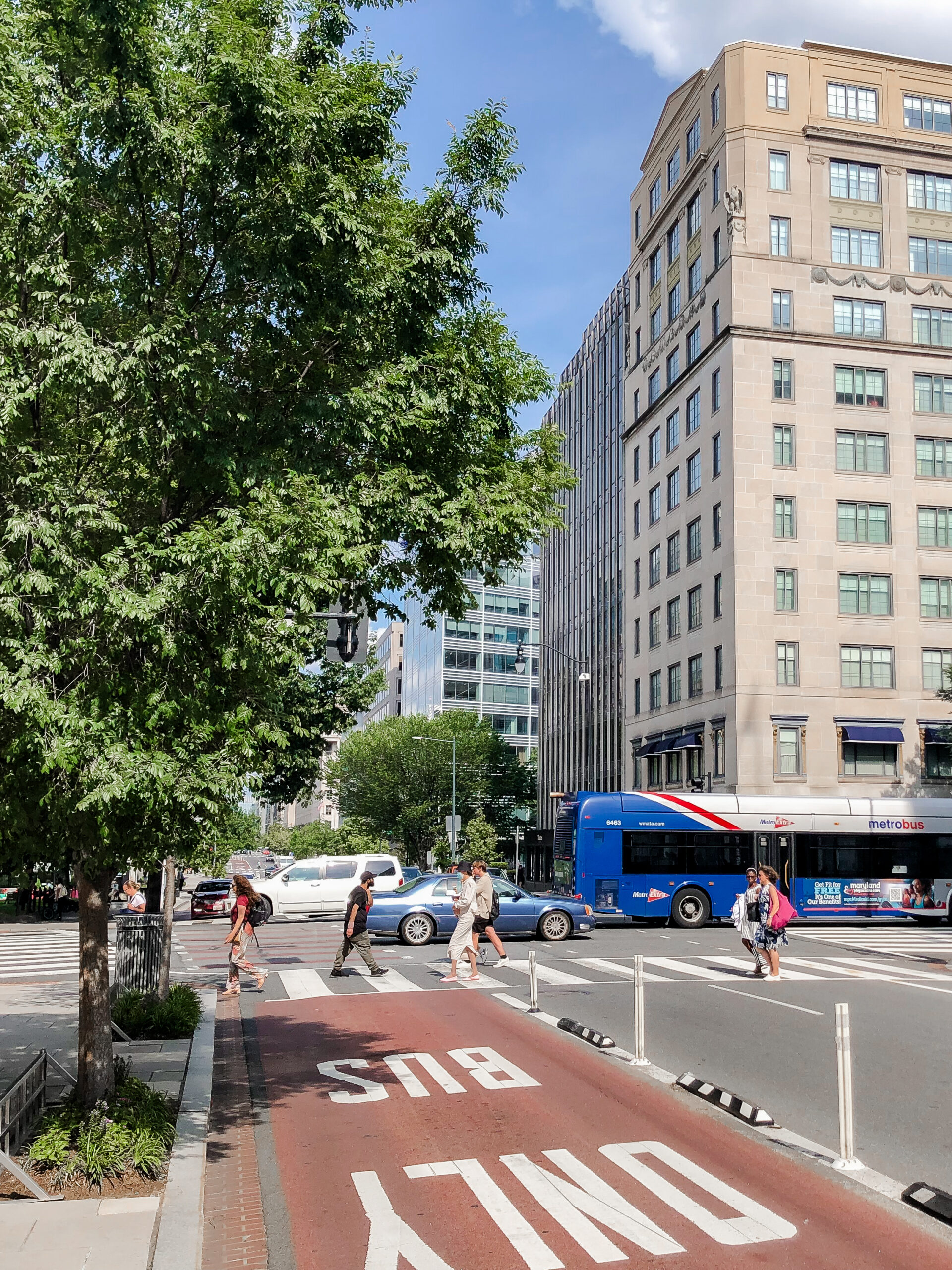
Streets are not merely places for movement. They are shared civic space. They are where children cross the street, buses kneel for passengers, and strangers model in their actions what they owe each other. A city is shared life with a sewer system underneath it. And thank goodness for that.
This is why the AV debate should be understandable to people who do not care about AVs. And not to say everyone should become an AV booster. The point is that people with very different priorities should be able to recognize their own hopes in the idea of a city that knows how to say yes. A safety advocate should be able to say, “I want my city to say yes to safer streets.” A transit advocate should be able to say, “I want my city to say yes to high-capacity mobility.” A housing advocate should be able to say, “I want my city to say yes to people being able to live near opportunity.” A climate advocate should be able to say, “I want my city to say yes to electrification.” A business advocate should be able to say, “I want my city to say yes to economic growth without surrendering the public interest.”
These are not competing visions in the abstract. They become competing visions only when cities fail to say what they are for, and how to get to yes.
The loudest people in public debates often have no such problem. The poles are very good at certainty. One side may believe the new thing must be good because it is new. The other may believe the new thing must be bad because it threatens an existing arrangement. But most people are not at the poles. Most people just want things to work. They want their neighborhood to be safe, their kids to have a future near them, their parents to remain mobile, their streets to be decent, their city to be solvent, and their leaders to know what they are doing. It really is a modest set of wants.
Of course, trust matters. People will accept change when they can see the upside and trust their leaders. They do not need perfection. They need seriousness. They need to know that someone has asked the right questions before the pilot begins or the permit is issued. They also need to know that the process is not a line to queue in outside a locked door.
And trust is not built by process alone. A government can follow every step and still lose the plot if it cannot deliver results. People trust institutions that are capable, responsive, and fair—not institutions that can produce a flawless record of why things don’t happen.
A city that knows how to say yes trusts but verifies. The answer is not to ask cities to be reckless, it is to ask them to be clear. A trusting city asks for evidence. It sets standards. It measures outcomes. It does not confuse a company’s ambitions with the public good. It also does not confuse a coalition’s anxiety with wisdom.
I say this as someone who makes a living helping cities study and generally make sense of complicated transportation questions. I am not anti-process. I am pro-process with an end point.
My point is not that cities should say yes to AVs, or to any future technology that arrives with promise. My point is that cities need a disciplined way to govern change: to be clear about the outcomes they want, identify the risks and tradeoffs they need to manage, and create a path to yes when public standards are met. AVs are one test of a city’s capacity to do this, but they will not be the last.
Here in DC, we did the responsible thing years ago and studied the potential for AVs to change the status quo in order to get ahead. That study and its conclusions continue to be useful. It says AVs are likely to increase vehicle miles traveled (VMT). That is a serious finding, and it should be taken seriously. However, VMT is not the problem on its own. The problems are the effects VMT can produce—congestion, emissions, crashes—and those are the things public policy should manage. This is not an anti-AV conclusion. It is a governance conclusion.
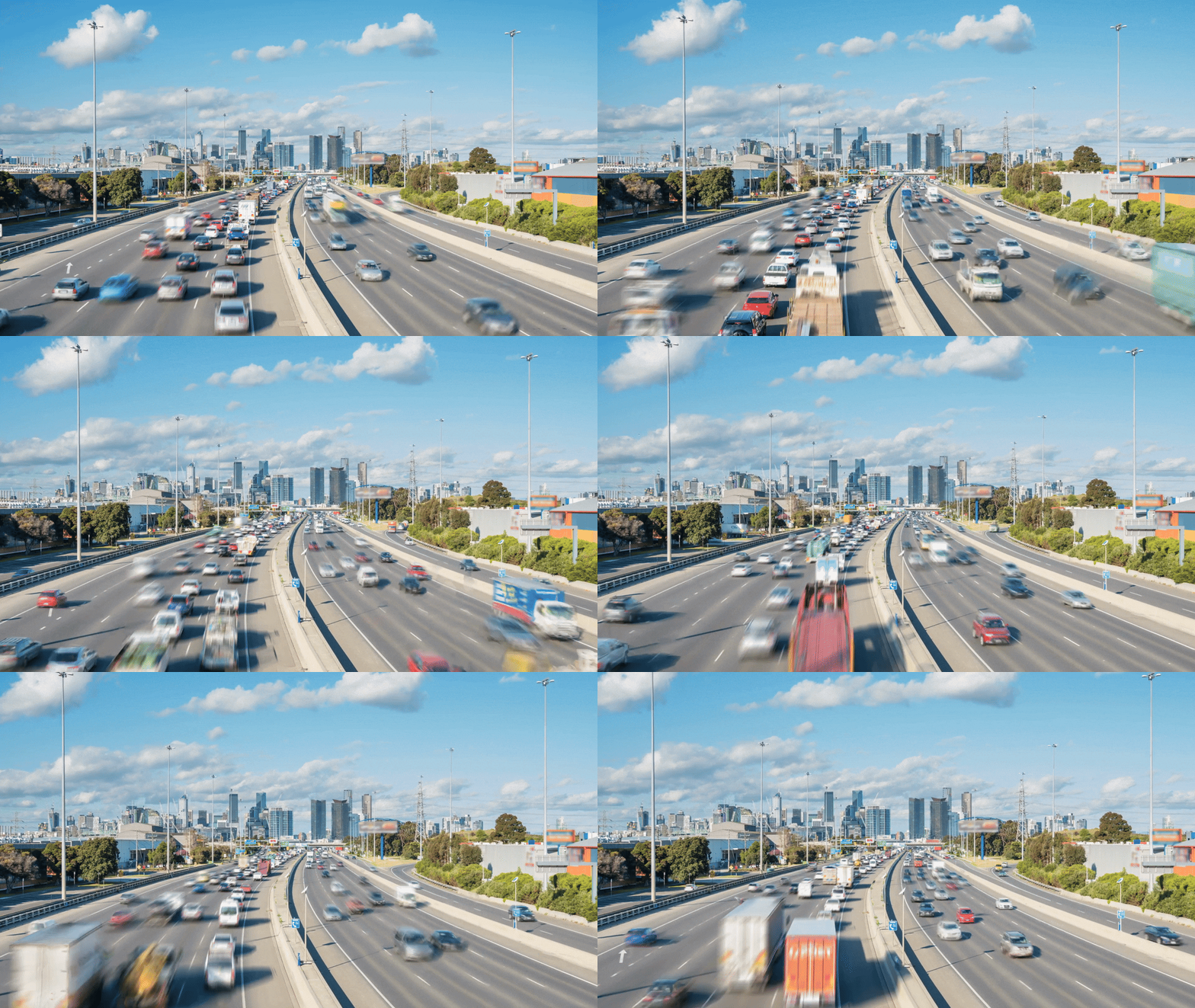
If the problem is congestion, price or manage congestion. If the problem is emissions, require electrification. If the problem is the potential for chaos at the curb, manage the curb. If the problem is labor disruption, build a transition policy instead of pretending jobs can be frozen in time. And if the problem is safety, set safety standards and compare performance against the actual human-driving baseline, not against an imagined world in which every driver is sober, insured, licensed, patient, alert, not looking at their phone, and making eye contact with pedestrians.
What cities should not do is use forecasts to launder values.
Forecasts are indispensable. Worst-case scenarios are often necessary to focus attention. They help us act before the bad thing happens. The ozone layer scare of my childhood was not fake; it was a warning that helped produce the appropriate response. If you don’t know what I’m talking about, ask your parents. The worst climate scenarios did useful work too. The lesson is not that climate change is over. Obviously not. The lesson is that serious people update when the world changes. Solar got better and cheaper. Batteries got better and cheaper. Natural gas replaced coal. Investment changed because it followed policy and rewards. China became the world’s solar energy factory. The worst-case scenario did useful work.
But once the world changes, the forecast has to change with it. A stress test cannot be maintained as the baseline in light of new information.
The same applies to AVs. “AVs could increase congestion” is a forecast-based concern. “Therefore we should make them nearly impossible to deploy” is a political judgment. Maybe it is a defensible judgment. But it should be argued as a judgment, not smuggled in as if a model made it so.
That is the central error of a city that does not know how to say yes. Most of this is not in bad faith. However, it allows one to hide behind abstractions. It may say “safety” when it means discomfort with change. It may say “equity” when it means preserving an incumbent. It may say “process” when it means delay. It may say “study” when it means veto. Eventually, nobody knows what the words mean anymore, including the people using them.
A confident city translates its values into rules.
This is especially true when a city is not simply regulating an existing market, but trying to regulate a market into existence.
However, it would be a mistake to write a dozen individually reasonable requirements that add up to a practical no. Every condition can sound defensible. A local testing requirement. A fleet cap. A fee. A labor provision. A study. A report. Another report. A discretionary approval. A safety review. A geographic equity requirement. A data requirement. A curb plan. A first-responder plan. None of these are absurd on their own. Many are good. But a neat stack of reasonable things can tip over and become a pile of no.
For AVs, rules could mean clear safety standards, data requirements, service expectations, and a performance-based path to scale. It also means consequences. A city should be able to say no when an operator fails. However, there must be a companion to no.
That companion is yes. Yes, if you meet the standards. Yes, if you reduce harm. Yes, if you serve the public. Yes, if your performance improves, you can scale. Yes, if the city is better off, we will not pretend otherwise because change is uncomfortable.
That is what confidence looks like. Not credulity. Not hostility.
The city that knows how to say yes knows what it is for. Maybe that sounds obvious—it isn’t. A lot of places know what they are against. Fewer can describe what they are willing to allow, reward, and protect. If a city is for safety, it says yes to safer streets. If it is for climate, it says yes to electrification and prices the real costs honestly. If it is for access, it says yes to new ways for people to reach jobs and each other. If it is for economic vitality, it says yes to tech and businesses that help the city grow without surrendering the public realm. If it is for accountability, it says yes in a way that can be monitored, enforced, and revised.
That is the conversation cities should be having now. Not whether every new idea deserves approval, but whether they have the standards, evidence, and trust to know when yes is warranted.
Progress does not require saying yes to everything.
But progress does require knowing what yes means.
A city that can do that is not surrendering control. It is using its control well.
Also by Eric: What Is Downtown DC For?
Eric has spent his career helping cities make sense of complicated transportation questions, from emerging technologies to the policies and tradeoffs that shape how people move. If your community is working through what it means to govern change well, he welcomes the conversation.
share this article
Connect with our Contributor

Eric Womeldorff
Practice Leader
Explore More

Get a First Look at the Generative AI Policy Starter Kit
We helped develop a new Generative AI Policy Starter Kit through ITE. Explore the Quick Bite and ITE Journal article now, and stay tuned for the full kit.
Intern Perspectives: A Summer in Transportation
What does a transportation internship actually look like? This summer, 25 interns across 14 of our offices gained hands-on experience with fieldwork, street design, GIS, data analysis, visual communication, client work, and community engagement. See what they learned, what surprised them, and how the experience shaped the way they think about careers in transportation.
Looking at Street Safety Through the Lens of Kinetic Energy
This ITE Technical brief explores how kinetic energy can add another dimension to roadway safety analysis, helping practitioners consider where conditions for serious harm may exist even before severe crash patterns emerge.