
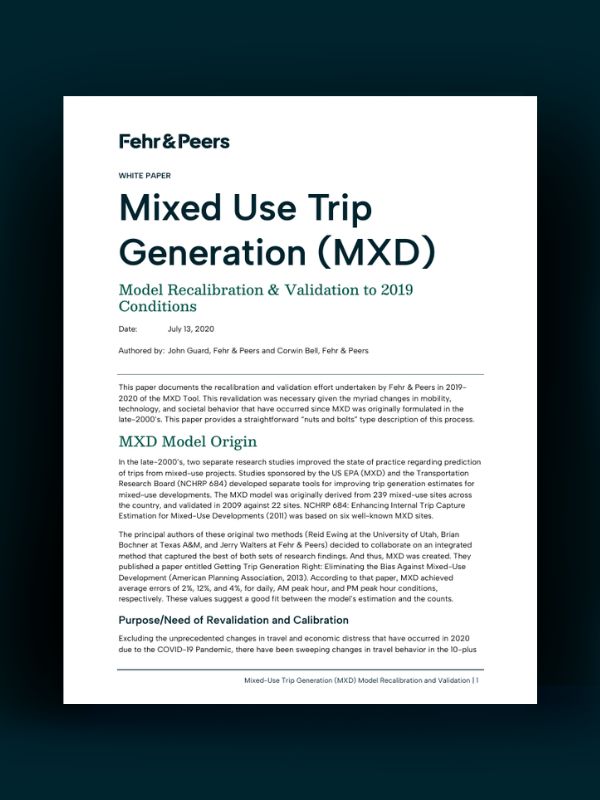
Estimating vehicle trips at mixed-use developments can be challenging. Most traditional trip generation rates are based on single-use suburban sites and don’t account for how people actually travel in mixed-use developments (MXD), where trips can happen internally or by walking, biking, or transit.
This white paper presents how we recalibrated and validated our MXD tool to reflect 2019 travel conditions. The update incorporates changes in travel behavior over the past decade, including the rise of ride-hailing services, e-commerce, telecommuting, and micromobility.
Using observed traffic data from mixed-use sites across the US, the updated MXD model produces more accurate estimates of daily and peak-hour vehicle trips, helping planners and communities better evaluate the transportation impacts of mixed-use developments.
Ready to read the white paper? Click the button below to access.
share this article
Contributor

John Gard
Principal
Email Me
Explore More

What Seattle’s Travel Trends Reveal About Post-Pandemic Mobility
The 2023 Puget Sound travel study revealed notable changes in how people get around. Our team identified emerging trends that may hold lessons for other regions.

The Ws of Safety: Treating the System, Not the Symptom
Our safety experts propose a Ws framework (who, what, when, where, and why) to strengthen the Safe System Approach and achieve Vision Zero 2.0.
FP Induced Vehicle Travel Analysis Technical Guidance
This guidance aids agencies in complying with California’s SB 743 by offering tools to quantify VMT impacts and evaluate mitigation strategies.