
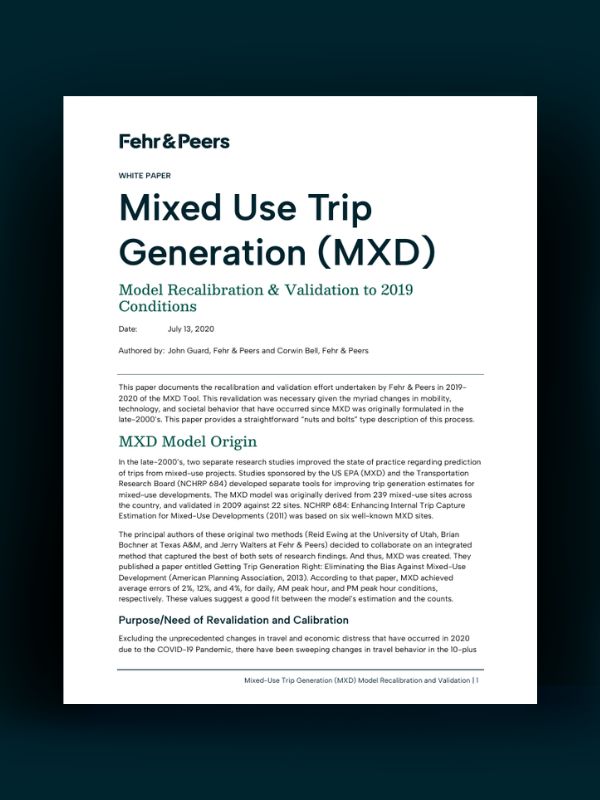
Estimating vehicle trips at mixed-use developments can be challenging. Most traditional trip generation rates are based on single-use suburban sites and don’t account for how people actually travel in mixed-use developments (MXD), where trips can happen internally or by walking, biking, or transit.
This white paper presents how we recalibrated and validated our MXD tool to reflect 2019 travel conditions. The update incorporates changes in travel behavior over the past decade, including the rise of ride-hailing services, e-commerce, telecommuting, and micromobility.
Using observed traffic data from mixed-use sites across the US, the updated MXD model produces more accurate estimates of daily and peak-hour vehicle trips, helping planners and communities better evaluate the transportation impacts of mixed-use developments.
Ready to read the white paper? Click the button below to access.
share this article
Contributor

John Gard
Principal
Email Me
Explore More

Leveraging Oregon Metro’s TSMO Strategy to Advance Regional Equity
Recipient of a “Diversity, Equity, and Inclusion Award” from the National Operations Center of Excellence, read how Oregon Metro developed a first-of-its-kind transportation systems management and operations (TSMO) strategy that focuses on the importance of evaluating the needs of an entire community.
Quantifying Greenhouse Gas (and VMT) Mitigation Measures
We are excited to share the release of an update to the CAPCOA Quantifying Greenhouse Gas Mitigation Measures. Over the past decade, practitioners have relied heavily on this key reference document for developing VMT and emissions mitigation measures.

Evolving Standard Validation Practices for Traffic Data
In part one of a two-part series on traffic volume estimation and StreetLight validation, we examine key questions to understand the possible variations for two industry standard methods.