
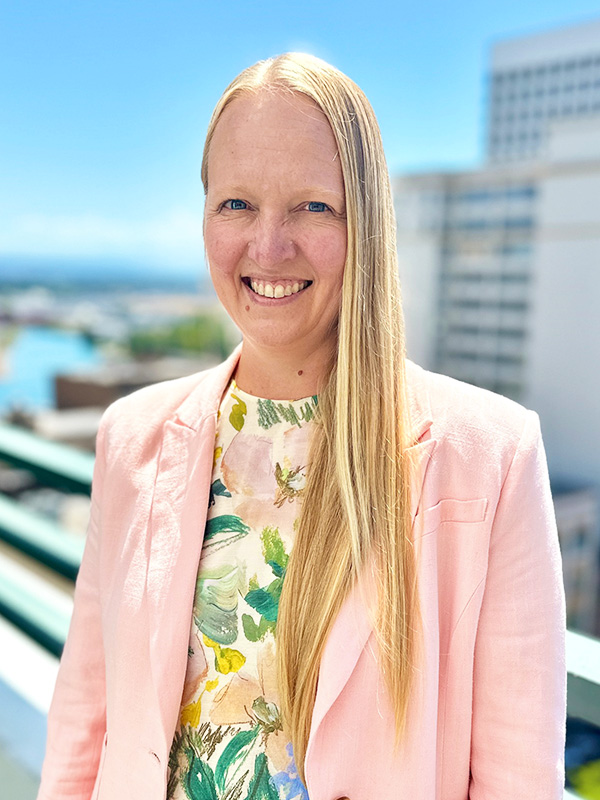
As climate risk increasingly shapes how communities plan, invest, and protect daily life, we’re expanding our ability to connect transportation decisions with climate adaptation and resilience. We are pleased to welcome Marissa Aho, FAICP, as a Principal and Practice Leader for our climate adaptation and resilience practice.
Marissa brings more than 20 years of experience helping communities, cities, regions, and state agencies reduce risk and prepare for a changing climate. Through her roles as a Chief Resilience Officer, she developed a practical approach to helping public agencies turn risk into priorities, partnerships, and investments they can act on. Based in our Tacoma, Washington office, she will support clients locally and nationally.
Her previous work with us in Southern California gives her a strong foundation in our collaborative approach. It also creates a natural next step: bringing climate resilience more directly into transportation decisions.
Helping Communities See the Full Picture
Marissa’s approach looks beyond a single hazard, project, or jurisdiction. Her expertise can help clients tangibly connect transportation services and infrastructure with the broader systems that shape daily life including water, energy, housing, emergency response, and long-term recovery. This systems view guides agencies to see where risks are growing and what is already working. It also points to near-term actions that can make communities safer and more resilient, especially when leaders are balancing urgent needs with long-term risk.
Marissa brings direct public sector experience leading major resilience efforts across the country, including Resilient Los Angeles, Resilient Houston, and King County’s Strategic Climate Action Plan. In Los Angeles, Marissa led a strategy to build the city’s resilience through leadership and engagement, disaster preparedness and recovery, economic security, climate adaptation, and infrastructure modernization.
In Houston, she led an award-winning strategy focused on immediate threats such as hurricanes and extreme heat, along with longer-term challenges like aging infrastructure and poor air quality. Within its first year, 90 percent of the strategy’s prioritized actions were already in progress or complete, even as implementation coincided with the first year of the COVID-19 pandemic. This work has become a foundational example for urban climate adaptation and disaster preparedness and has since been used by FEMA and other federal agencies as a case study and reference strategy.
Her ability to collaborate across scales, from individual properties and neighborhoods to cities and regions, contributed to her induction this year as a Fellow of the American Institute of Certified Planners.
Connecting Climate Resilience and Transportation Decisions
Our climate resilience and evacuation work has been at the intersection of climate change and transportation for nearly two decades, helping clients navigate topics like vehicle miles traveled and greenhouse gas reduction policies and evacuation planning. Marissa builds on that foundation with firsthand climate resilience experience that connects climate adaptation, hazard mitigation, equity, the social and economic realities of resilience to transportation decisions, including long-range planning, forecasting, safety, freight, and infrastructure investment. Just as important, she translates those connections into actions that can be funded, measured, and implemented.
Marissa also brings a strong teaching and thought leadership background, including resilience instruction at the University of Southern California. That experience reflects one of her many strengths: making complex decisions easier to understand, discuss, and act on.
We are excited to welcome Marissa to the team and look forward to the ways her leadership will help communities build safer, more resilient places. Outside of work, she spends time in her garden and kayaking in her neighborhood bay. Both are fitting places for someone who thinks deeply about the connections between people, place, and resilience.
share this article
Explore More
Congratulating Our Newest Shareholders
Our 2026 shareholders followed different paths to reach this career milestone, but they all share a proven dedication to delivering thoughtful, high-quality work for clients, supporting their colleagues, and strengthening the communities where we practice.

Celebrating Our Lifelong Learners
We thank our dedicated team members who have gone the extra mile to earn certifications and licenses during the past year.
Planning for the Future of E-Micromobility
E-bike and e-scooter usage continues to expand nationwide, creating challenges for planners. These two papers explain what’s happening and how we can help our clients prepare for the future.