

Are project site TDM mitigation strategies reliable?
Since implementation of SB 743 in 2020, lead agencies using VMT have had questions emerge about VMT mitigation. One of these questions asks about the reliability of project site transportation demand management (TDM) mitigation strategies, such as those contained in Quantifying Greenhouse Gas Mitigation Measures (CAPCOA, 2021). The simple answer is that the effectiveness of these strategies depends on the performance of building tenants that can change over time. Ensuring effectiveness requires ongoing monitoring and strategy adjustment.

What is the concept of VMT mitigation banks and exchanges?
This answer has led to growing interest in program-based approaches to mitigation that can improve mitigation certainty. In 2019, U.C. Berkeley released a white paper describing the new concept of VMT mitigation banks and exchanges. Fehr & Peers, in collaboration with WRCOG, recently released a complement to the U.C. Berkeley paper that directly compares VMT mitigation banks and exchanges to traditional impact fee programs for deeper understanding. Further, the new white paper also contains specifics on potential legal requirements, and outlines the creation and implementation steps for each type of program with procedural flow charts. Program examples and implementation risks are also provided, making the paper an information-rich source for lead agencies seeking to successfully navigate the complexity of VMT mitigation strategies. Read the full white paper below.

share this article
Explore More
Partnering from Concept to Construction
With a passion for bringing transportation concepts into reality, we partner with our clients on many projects from initial plans and prioritization through to construction. Learn how we worked to integrate complete streets solutions in Honolulu, Hawaii from concept all the way through implementation.
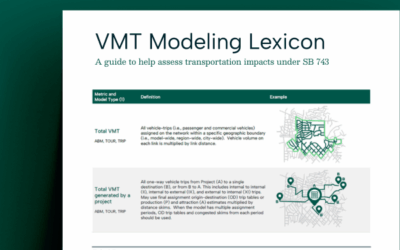
Understanding VMT Metrics: Explore Our Modeling Lexicon
CEQA’s July 1 deadline is swiftly approaching, making it increasingly important to be able to understand and navigate all types of VMT calculations. Our new quick-reference VMT lexicon makes that easier. Explore it now here.

Navigating Long-Term Transit: Planning in an Uncertain Time
We’re partnering with the Whatcom Transportation Authority in Bellingham, Washington to plan the long-term future and develop a strategy for restarting transit service, welcoming back riders, and ensuring riders can safely get where they would like to go. See what’s in the works.