VMT Mitigation Program Implementation Flowcharts
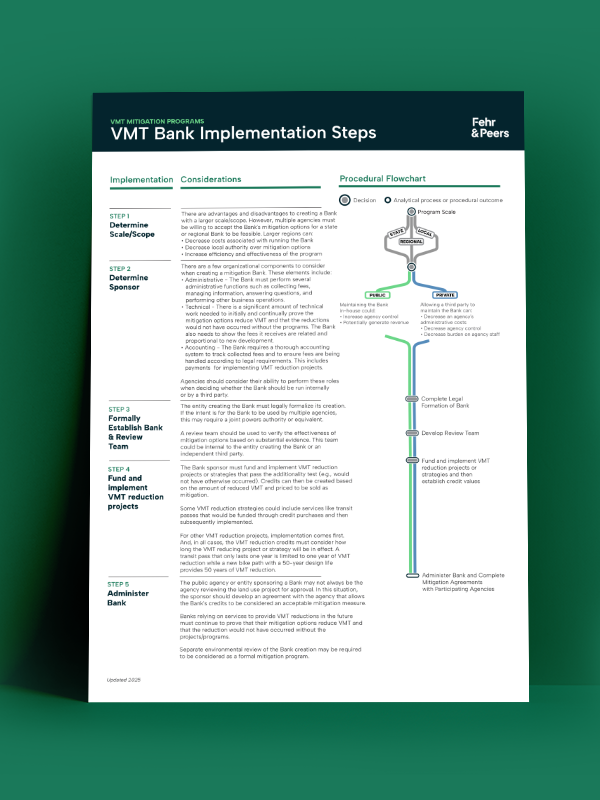
This resource package helps public agencies, regional partners, and development teams compare three common VMT mitigation approaches: VMT Banks, VMT Exchanges, and VMT Impact Fee Programs.
Each flowchart breaks down key steps and considerations, including program scale, sponsorship, mitigation effectiveness, legal formation, nexus requirements, interagency agreements, environmental review, and long-term monitoring. Together, they offer a practical starting point for understanding which approach may fit a community’s needs and what it can take to move from concept to implementation.
These resources may be especially useful when agencies and development teams are exploring clearer, more consistent ways to address VMT impacts while balancing technical, legal, and administrative considerations.
share this article
Explore More
What Is Downtown DC For?
The DC decongestion pricing study landed years late in a city that looks nothing like the one it studied. What is the debate really about?
Coordinating the Curb, Not Just Reacting to It
Walnut Creek’s curbside management plan took them from reactive fixes to a more coordinated, goal-driven framework for their suburban downtown. Here’s what changed, and what other agencies can learn from it.
Rethinking Street Design for Safety and Emergency Access
This February 2026 ITE Journal article shows how connected street networks and cross-department collaboration can help communities balance everyday safety with reliable emergency access.
Section Heading Goes Here
Lorem ipsum dolor sit amet, consectetur adipiscing elit, sed do eiusmod tempor incididunt ut labore et dolore magna aliqua. Ut enim ad minim veniam, quis nostrud exercitation ullamco laboris nisi ut aliquip ex ea commodo consequat. Duis aute irure dolor in reprehenderit in voluptate velit esse cillum dolore eu fugiat nulla pariatur. Excepteur sint occaecat cupidatat non proident, sunt in culpa qui officia deserunt mollit anim id est laborum.
Subsection Heading Goes Here
Lorem ipsum dolor sit amet, consectetur adipiscing elit, sed do eiusmod tempor incididunt ut labore et dolore magna aliqua. Ut enim ad minim veniam, quis nostrud exercitation ullamco laboris nisi ut aliquip ex ea commodo consequat. Duis aute irure dolor in reprehenderit in voluptate velit esse cillum dolore eu fugiat nulla pariatur. Excepteur sint occaecat cupidatat non proident, sunt in culpa qui officia deserunt mollit anim id est laborum.
share this article
Connect with our Contributors
First Name Last Name
Forecasting Practice Leader
AICP, PTP
Email Me
First Name Last Name
Forecasting Practice Leader
AICP, PTP
Email Me
First Name Last Name
Forecasting Practice Leader
AICP, PTP
Email Me
First Name Last Name
Forecasting Practice Leader
AICP, PTP
Email Me
First Name Last Name
Forecasting Practice Leader
AICP, PTP
Email Me
First Name Last Name
Forecasting Practice Leader
AICP, PTP
Email Me
First Name Last Name
Forecasting Practice Leader
AICP, PTP
Email Me
First Name Last Name
Forecasting Practice Leader
AICP, PTP
Email Me
First Name Last Name
Forecasting Practice Leader
AICP, PTP
Email Me
Explore More
What Is Downtown DC For?
The DC decongestion pricing study landed years late in a city that looks nothing like the one it studied. What is the debate really about?
Coordinating the Curb, Not Just Reacting to It
Walnut Creek’s curbside management plan took them from reactive fixes to a more coordinated, goal-driven framework for their suburban downtown. Here’s what changed, and what other agencies can learn from it.
Rethinking Street Design for Safety and Emergency Access
This February 2026 ITE Journal article shows how connected street networks and cross-department collaboration can help communities balance everyday safety with reliable emergency access.