
VMT Mitigation Program Implementation Flowcharts
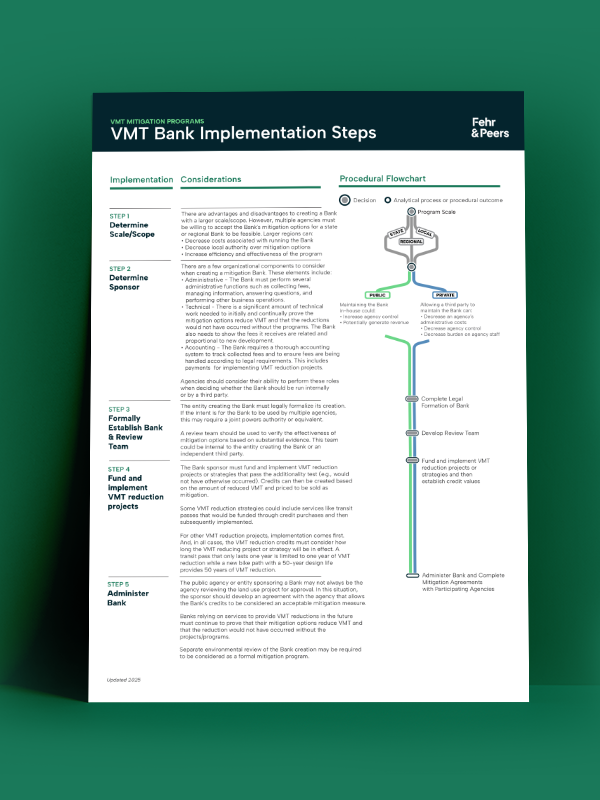
VMT Mitigation Program Implementation Flowcharts
This resource package helps public agencies, regional partners, and development teams compare three common VMT mitigation approaches: VMT Banks, VMT Exchanges, and VMT Impact Fee Programs.
Each flowchart breaks down key steps and considerations, including program scale, sponsorship, mitigation effectiveness, legal formation, nexus requirements, interagency agreements, environmental review, and long-term monitoring. Together, they offer a practical starting point for understanding which approach may fit a community’s needs and what it can take to move from concept to implementation.
These resources may be especially useful when agencies and development teams are exploring clearer, more consistent ways to address VMT impacts while balancing technical, legal, and administrative considerations.
share this article
Explore More
Model Assessment Criteria for CEQA
Agencies should evaluate their models to ensure they provide reliable forecasts and meet CEQA standards for environmental impact analyses.
VMT Agency Decision Matrix
This guide helps agencies choose the right methods and tools to measure Vehicle Miles Traveled (VMT) for land use and transportation projects, supporting compliance with California’s SB 743.
Street Safety in an Autonomous Vehicle Future
Autonomous vehicles may have the potential to support core elements of the Safe System approach, which strives to eliminate fatal and serious transportation injuries. Fehr & Peers partnered with ITE to publish “Autonomous Vehicle Considerations under a Safe System Framework,” which explores potential AV benefits, risks, and considerations within the Safe System framework.