
Street Safety in an Autonomous Vehicle Future
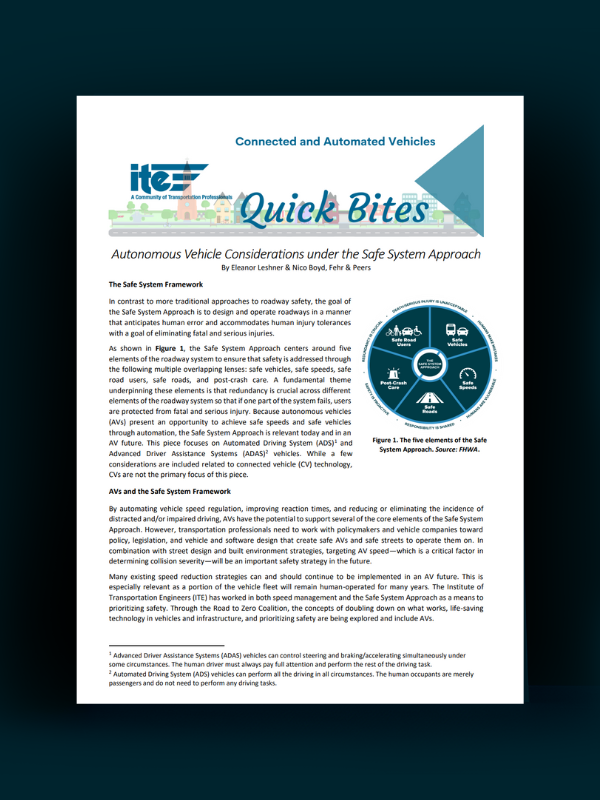
Street Safety in an Autonomous Vehicle Future
In contrast to more traditional roadway safety approaches, the Safe System approach strives to design and operate our vehicles and infrastructure in a manner that anticipates human error and accommodates human injury tolerances with a goal of eliminating fatal and serious injuries. By automating vehicle speed regulation, improving reaction times, and reducing or eliminating the incidence of distracted and/or impaired driving, autonomous vehicles (AVs) have the potential to support several core elements of the Safe System approach. However, recent trends in traffic-related pedestrian deaths and speeding-related collisions raise increasing concerns and a need for transportation professionals to work with policymakers and vehicle companies toward policy, legislation, and vehicle/software design that create safe AVs—and safe streets to operate them on.
As a direct result of these alarming trends and uncertainty regarding the potential impacts of AVs on safety outcomes, Fehr & Peers partnered with ITE to publish “Autonomous Vehicle Considerations under a Safe System Framework,” which provides a concise summary of potential AV benefits, risks, and other considerations within the Safe System framework. For a more detailed look at street safety considerations for an AV future, we invite you to explore the ITE “Quick Bite.” The article highlights how transportation engineers and planners can design roadways taking “evergreen” safety principles into account, both for today and in the future.
share this article
Explore More

Driving Less Starts with Building Differently
How much can planning decisions actually reduce driving? Our latest research introduces a statistical model that links built environment choices—such as density, transit service, walkability, and land use mix—to vehicle miles traveled (VMT). The findings give planners and policymakers practical, evidence-based tools to evaluate scenarios, understand tradeoffs, and make more informed transportation and land use decisions.
Navigating VMT Under CEQA
VMT under CEQA continues to evolve as agencies, practitioners, and decision makers work through analysis methods, mitigation feasibility, and defensible evidence. Our new Q&A resource offers practical answers on vehicle miles traveled, SB 743, mitigation program design, implementation, administration, and legal and strategic considerations.
Demand Management Is Injury Prevention
New research shows that reducing driving exposure may be one of the most powerful safety strategies available. The findings connect VMT, mode share, and travel time to fatality rates, reframing demand management as injury prevention.