
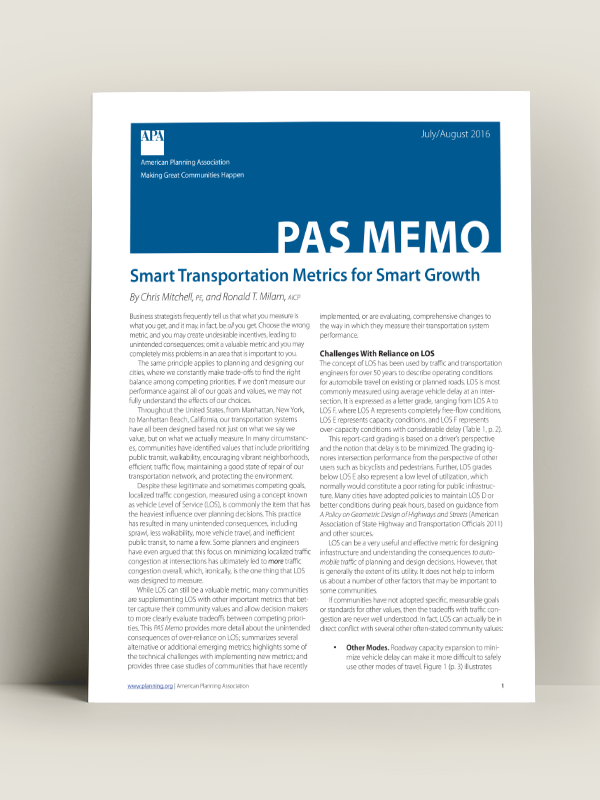
Explore the Planning Advisory Service (PAS) Memo
State-of-the-practice analytical methods should be employed when estimating the trip generation of mixed-use projects. Our recent update and revalidation of MXD+ provides planners with a method more accurate than ever for performing such estimates, which are a critical part of the land use development and environmental review process. In the November/December 2020 issue of the American Planning Association’s PAS Memo, entitled “Still Getting Trip Generation Right: Revalidating MXD+,” Principal John Gard and Transportation Planner Corwin Bell describe the advantages, analysis techniques, and use of MXD+ through actual site case studies. We invite you to read the details in the memo and reach out to us with questions or discussion.
share this article
Explore More

Driving Less Starts with Building Differently
How much can planning decisions actually reduce driving? Our latest research introduces a statistical model that links built environment choices—such as density, transit service, walkability, and land use mix—to vehicle miles traveled (VMT). The findings give planners and policymakers practical, evidence-based tools to evaluate scenarios, understand tradeoffs, and make more informed transportation and land use decisions.
Navigating VMT Under CEQA
VMT under CEQA continues to evolve as agencies, practitioners, and decision makers work through analysis methods, mitigation feasibility, and defensible evidence. Our new Q&A resource offers practical answers on vehicle miles traveled, SB 743, mitigation program design, implementation, administration, and legal and strategic considerations.
Demand Management Is Injury Prevention
New research shows that reducing driving exposure may be one of the most powerful safety strategies available. The findings connect VMT, mode share, and travel time to fatality rates, reframing demand management as injury prevention.