
Leveraging Grant Funds to Reach Vision Zero
Leveraging Grant Funds to Reach Vision Zero
In an ongoing effort to develop safe transportation systems, Secretary Buttigieg and the USDOT have led the charge by demonstrating a commitment to Vision Zero and the Safe System Approach as the way to get there. The National Roadway Safety Strategy, and now the Safe Streets and Roads for All (SS4A) funding to implement that strategy, are providing a critical roadmap for the US as we address the road safety crisis in this country.
Acquiring funding through grants and safety programs can be a daunting task, but with appropriate planning and guidance, the application process can be an easy first step in creating safe infrastructure systems.
We are excited to support our clients as the SS4A funding opportunity rolls out. Below is key information about the new funding program to help your agency prepare.
Safe Streets and Roads for All (SS4A) – Program Essentials
- $5B in grant funding over the next five years
- Funds regional, local, and Tribal initiatives through grants to prevent roadway deaths and serious injuries
- Funds available for Action Plan development and Implementation
- More details
Navigating the Application
Which funds does our agency apply for?
To be eligible for an Implementation Grant, your agency must have a safety plan or other public document that meets the grant-defined requirements for a Comprehensive Safety Action Plan. If your agency is close, but not completely compliant, there may be low effort ways to become compliant and make your agency eligible for Implementation funding.
Eligibility For Implementation Funding
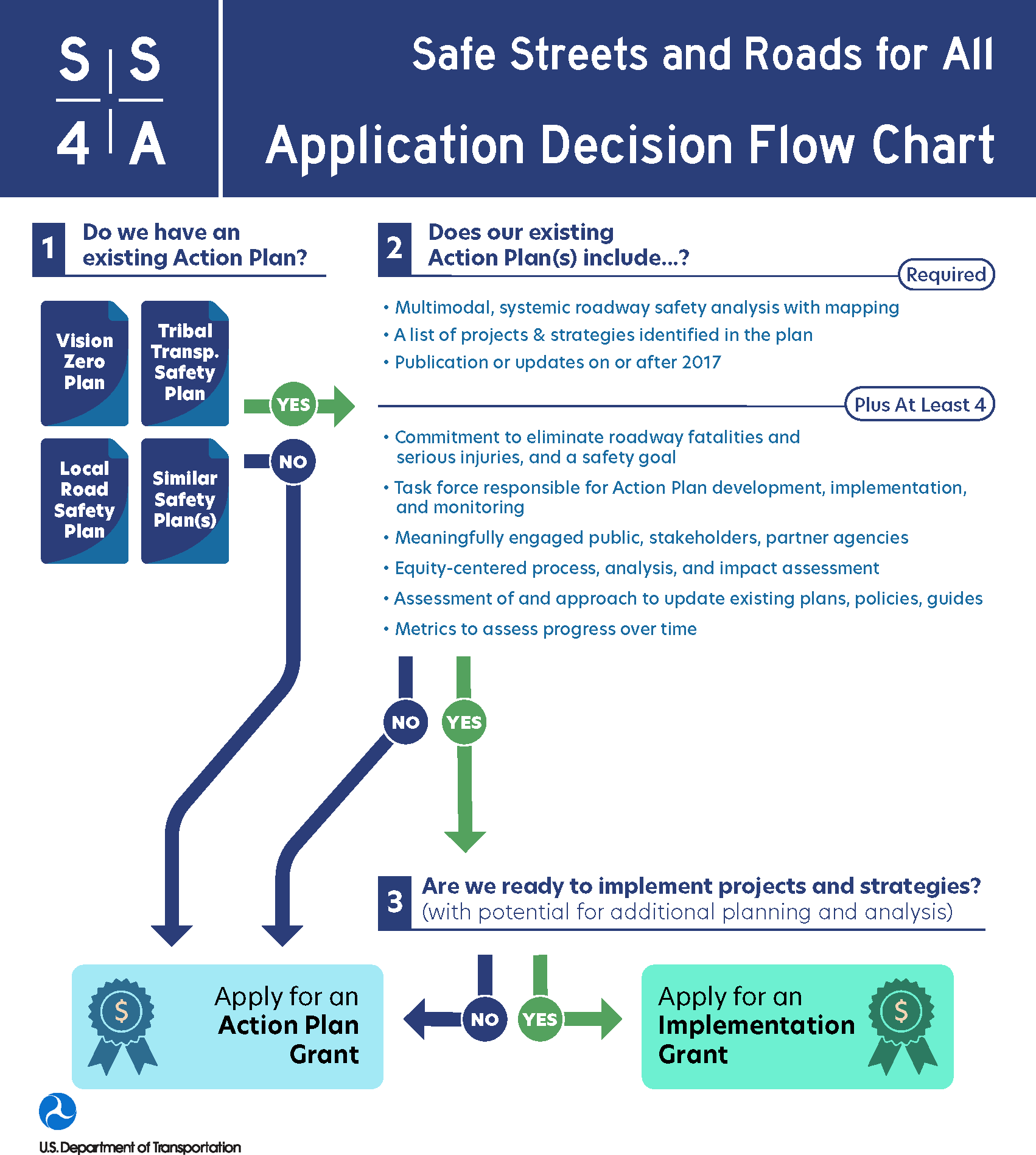
To be eligible for Implementation funding, your agency must have a publicly available plan that meets the three following requirements:
1. Contains analysis of:
-
- Existing and historic fatal and severe injury crash trends across the jurisdiction
- Crash location, severity, contributing factors and crash types
- Systemic and site-specific safety needs
- Geospatial identification of high-risk locations
2. Contains a comprehensive set of projects and strategies, including timeframe for deployment and explanation of prioritization criteria
3. Finalized or updated between 2017 and 2022
AND your agency’s plan must meet at least four of the following six requirements:
1. High-ranking official(s) have publicly committed to a zero fatality and serious injury goal AND the commitment included a target date to reach zero or a target date to achieve significant declines
2. A task force was established and charged with the plan’s development, implementation, and monitoring
3. Plan development included engagement with the public and relevant stakeholders, their feedback was incorporated into the plan, and collaboration occurred with government departments within and outside the jurisdiction (e.g., transit agencies)
4. Plan includes considerations of equity using inclusive processes, identification of underserved communities through data, and equity impact assessment
5. Plan includes assessment of current plans, policies, guidelines, and standards to identify opportunities for improvement AND discusses implementation through adoption of revised policies, guidelines or standards
6. Plan includes description of how progress will be measured over time AND plan is publicly posted online
Alternative Funding Opportunities
If your agency is in California, you may want to consider another important safety funding source – the Highway Safety Improvement Program (HSIP). Cycle 11 currently is open, with applications due September 12, 2022.
For California Cycle 11, key new elements of this cycle include:
- LRSP or other certified safety plan is required to be eligible for funding
- Set asides are available for bike lane or separated bike lane projects
- Advanced Dilemma Zone Detection countermeasure was removed/li>
- Mini roundabout countermeasure (with 30% CRF) was added
- Pre-COVID-19 crash data can be used
- Analyzer tool was updated to look at different location types together
Learn more about other state HSIP programs.
Experience with Grant Funding and Implementation Efforts
Fehr & Peers is proud to have been an early collaborator on Vision Zero and Safe System, in particular through our work with cities on their Vision Zero and Local Road Safety Plans; with regional agencies on their Vision Zero How-To Guides, data analysis and technical support; and with state and national organizations on their Strategic Highway Safety Plan pivots to Safe System, policy and communication frameworks, institutionalization efforts, and Core Elements benchmarks. Our continuing roles supporting the Institute of Transportation Engineers and Johns Hopkins School of Public Health on Safe System policy setting and education are also keeping us at the forefront of this emerging and exciting shift for multimodal safety.
For questions about these safety funding sources or safety initiatives in your community:
share this article
Explore More
Re-envisioning Long-Range Transportation Plans
Explore how four communities shifted their plans’ focus from a more traditional emphasis on vehicle capacity and roadway expansion to planning systems oriented around people.

Equity & Infrastructure Improvements
It’s not always clear which community members and roadway users are likely to benefit from large-scale infrastructure investments. Learn how activity-based models can help.
Fehr & Peers in Dallas, Texas
We are excited to announce our expansion to Texas! With proximity to downtown Dallas, establishing roots here allows us to continue to provide for and deepen our relationships with clients in the DFW Metroplex and beyond.