
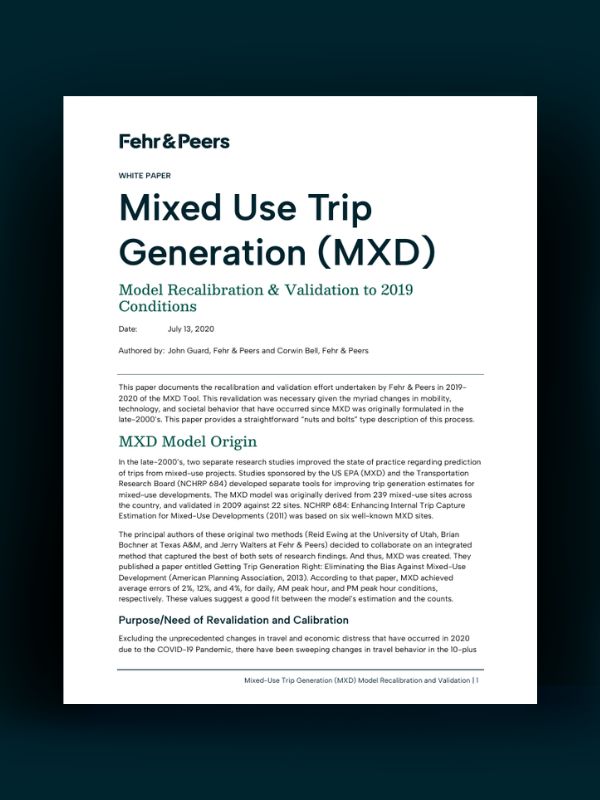
Estimating vehicle trips at mixed-use developments can be challenging. Most traditional trip generation rates are based on single-use suburban sites and don’t account for how people actually travel in mixed-use developments (MXD), where trips can happen internally or by walking, biking, or transit.
This white paper presents how we recalibrated and validated our MXD tool to reflect 2019 travel conditions. The update incorporates changes in travel behavior over the past decade, including the rise of ride-hailing services, e-commerce, telecommuting, and micromobility.
Using observed traffic data from mixed-use sites across the US, the updated MXD model produces more accurate estimates of daily and peak-hour vehicle trips, helping planners and communities better evaluate the transportation impacts of mixed-use developments.
Ready to read the white paper? Click the button below to access.
share this article
Contributor

John Gard
Principal
Email Me
Explore More

Fehr & Peers Tacoma Opens its Doors
Our new Tacoma office will allow us to continue to grow, better serving our existing and new clients, and giving our staff the opportunity to call the South Sound home.
TDM Strategies Technical Memorandum
This information can be used as part of the SB 743 implementation to determine potentially feasible VMT mitigation measures for individual land use projects in the WRCOG area.

Cincinnati Curb Study
In Cincinnati, as in many cities, curb space is a scarce resource. With multiple modes of transportation vying for access to the curb — from personal vehicles, buses, commercial vehicles and rideshare vehicles, to bicycles and pedestrians — Cincinnati has joined the ranks of cities around the world that are looking for ways to make curb space safer and more efficient.