
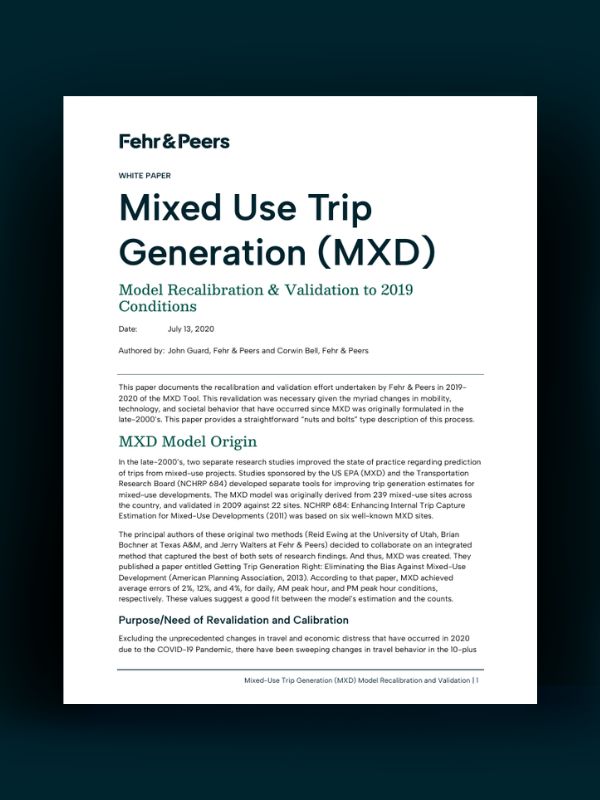
Estimating vehicle trips at mixed-use developments can be challenging. Most traditional trip generation rates are based on single-use suburban sites and don’t account for how people actually travel in mixed-use developments (MXD), where trips can happen internally or by walking, biking, or transit.
This white paper presents how we recalibrated and validated our MXD tool to reflect 2019 travel conditions. The update incorporates changes in travel behavior over the past decade, including the rise of ride-hailing services, e-commerce, telecommuting, and micromobility.
Using observed traffic data from mixed-use sites across the US, the updated MXD model produces more accurate estimates of daily and peak-hour vehicle trips, helping planners and communities better evaluate the transportation impacts of mixed-use developments.
Ready to read the white paper? Click the button below to access.
share this article
Contributor

John Gard
Principal
Email Me
Explore More

SB 743 White Paper
SB 743 requires evaluating transportation impacts using VMT instead of Level of Service (LOS).

New Office in the Central Valley
Fehr & Peers proudly announces the opening of our Central Valley satellite office! Located in the heart of downtown Stockton, this office will help us continue to provide for and deepen our relationships with current Central Valley clients while further expanding our ability to serve the region.

VMT & GHG Reduction Strategies
Strategies like transit-oriented development, increasing residential density, and improving street connectivity can significantly reduce VMT and GHG emissions, with some measures achieving reductions of up to 31%.