
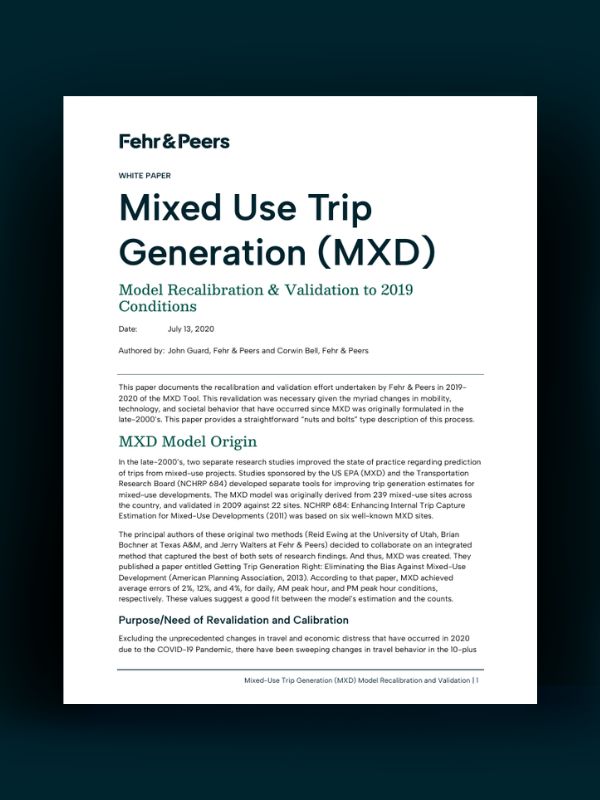
Estimating vehicle trips at mixed-use developments can be challenging. Most traditional trip generation rates are based on single-use suburban sites and don’t account for how people actually travel in mixed-use developments (MXD), where trips can happen internally or by walking, biking, or transit.
This white paper presents how we recalibrated and validated our MXD tool to reflect 2019 travel conditions. The update incorporates changes in travel behavior over the past decade, including the rise of ride-hailing services, e-commerce, telecommuting, and micromobility.
Using observed traffic data from mixed-use sites across the US, the updated MXD model produces more accurate estimates of daily and peak-hour vehicle trips, helping planners and communities better evaluate the transportation impacts of mixed-use developments.
Ready to read the white paper? Click the button below to access.
share this article
Contributor

John Gard
Principal
Email Me
Explore More

VMT Factors Specific to California Senate Bill 743
Traditional traffic models often miss current travel patterns. Our new method uses recent data to better estimate how much people drive, helping with SB 743 compliance.

SB 743 Overview
This overview details the advantages of using location-based services (LBS) data over traditional travel demand models, outlines the methodology for calculating VMT, and offers definitions for key metrics segmented by trip purpose and residence classification.

Introducing Five New Shareholders
Through hard work, dedication, and passion for their work, we congratulate the newest shareholders of Fehr & Peers.