

We’re thrilled to welcome Rebecca Sanders, PhD, RSP2B, to our Portland office! She brings nearly two decades of academic and consulting experience focused on pedestrian, bicyclist, and micromobility safety. Rebecca founded Safe Streets Research & Consulting, a firm recognized for transportation safety research and data analysis, which became part of Fehr & Peers in March 2026. She has led critical research and guided agencies across the country toward more proactive approaches to transportation safety.
Specialized Safety Expertise to Help Clients Act Earlier
Rebecca is passionate about safety and collaborating with agencies to shift from reacting to crashes toward proactively identifying and addressing risks before serious injuries occur. Her expertise spans roadway user behaviors and influences, proven countermeasure selection, and safety modeling that informs better decisions about where and how to act. That approach has shaped a range of projects, from local roadway safety plans to the Bay Area Rapid Transit (BART) Safety Action Plan for Roadways, the San Diego Association of Governments (SANDAG) Vision Zero Action Plan and Regional Active Transportation Plan, and Caltrans’ Roadway Safety Improvement Plans. Across these efforts, she directed the analysis to identify systemic safety factors, developed high-injury networks to help agencies focus their efforts, helped clients apply a Safe System lens to countermeasure selection, and guided prioritization and policy strategy. In each case, the goal was not just to understand existing conditions, but to give teams a clearer path to meaningful safety improvements in the near and far term by connecting insights about root causes and human behavior to critical safety opportunities. As Rebecca puts it, “Reactive safety work helps us understand patterns, but the real opportunity is to address risks before injuries occur.” That perspective supports earlier, coordinated, and multidisciplinary action, reducing the exposure, likelihood, and severity risk factors for injury. For her, it comes down to how transportation affects people’s lives: “A safer street isn’t just about design and operations decisions, it’s about whether someone makes it home.”
Research for Complex Challenges
Rebecca also brings specialized depth in some of transportation safety’s most persistent and difficult issues. Her research regularly shapes national guidance and advances how practitioners approach challenges through a Safe System lens. Recently, she led the research and co-authored the guidance for NCHRP 1157, focused on improving pedestrian safety in darkness. She is also updating national recommendations for marked crosswalk design, spacing, placement, and safety, as well as the countermeasures needed to support marked crosswalks, through NCHRP 17-115 and NCHRP 03-143. In addition, she co-authored the guidance for NCHRP 17-111 to advance speed management strategies for pedestrian and bicyclist safety along arterials and higher-speed roadways. Across this work, she connects rigorous research with practical tools agencies can use to improve safety and multimodal connectivity in the field. In her practice, she aims to better integrate the various parts of the system—the transportation policies, funding, and implementation decisions—to improve real people’s daily lives. That includes people walking, biking, using transit, driving, and those with disabilities, who are too often underserved in systems that prioritize vehicle speed and throughput over safety, access, and the needs of people using other modes.
Strengthening Safety Leadership in Portland and Beyond
Based in Portland, Rebecca incorporates a national perspective and local experiences in her new role. In addition to supporting partners across the region, she has served the Portland community through her role on the City of Portland’s Pedestrian Advisory Committee and Dark Skies Committee. Nationally, she served as chair of TRB’s Bicycle Committee and as an appointed member of California’s Vehicle Weight Safety Task Force. Now, as a Principal on our team, she strengthens our ability to address complex safety challenges in Portland and beyond. We are excited to welcome Rebecca to the team and look forward to the impact her work will have across the communities we serve.

share this article
Explore More
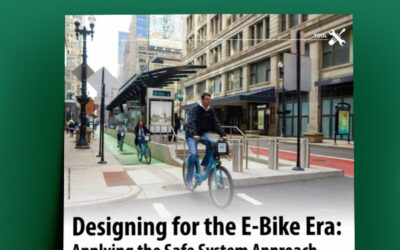
E-Bike Safety Takes More Than Regulation
E-bikes can replace longer car trips and reduce vehicle miles traveled, but regulating devices alone won’t make riding safer. A September 2026 ITE Journal article applies the Safe System Approach to show why communities need both connected, low-stress networks and effective policies.

The Generative AI Policy Starter Kit is Here
We helped develop a new Generative AI Policy Starter Kit for agencies, firms, and other organizations developing or refining their own AI guidance. Explore it through a Quick Bite, ITE Journal article, and online resource.
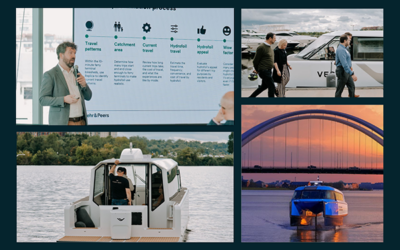
What Hydrofoil Service Could Look Like in Washington, DC
Could electric hydrofoils offer a faster way to travel between waterfront neighborhoods in Washington, DC? Our feasibility study found potential ridership demand and tested how routes, fares, and service frequency could shape a future pilot. The approach also offers a way for other communities to evaluate emerging transportation ideas before committing significant resources.