
Looking at Street Safety Through the Lens of Kinetic Energy
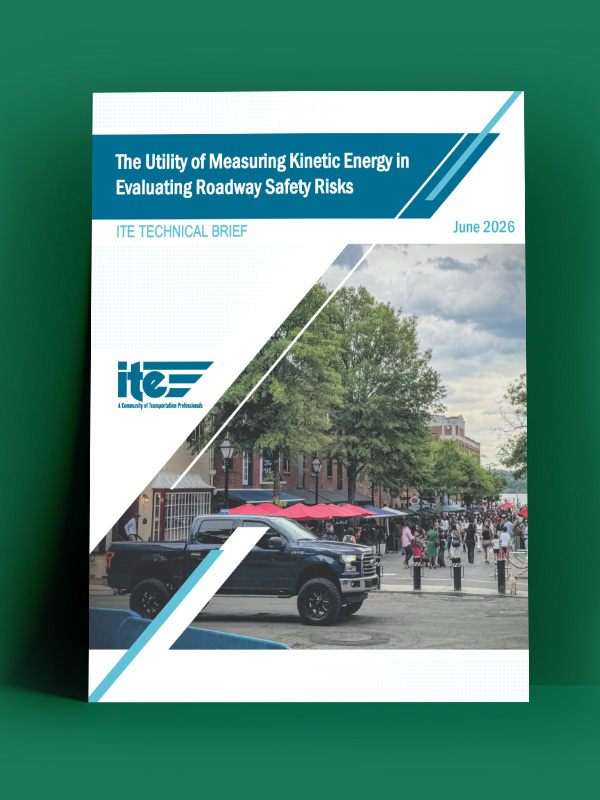
Looking at Street Safety Through the Lens of Kinetic Energy
A street may have little or no history of severe crashes. But that doesn’t necessarily mean the potential for serious harm isn’t there or that people feel safe on these streets.
Kinetic energy is a valuable roadway safety analysis tool that helps practitioners proactively evaluate roadway safety risks. It can help identify conditions where serious harm is possible, even before a pattern of severe crashes develops.
A new ITE technical brief, The Utility of Measuring Kinetic Energy in Evaluating Roadway Safety Risks, explores how practitioners can put that idea into practice, using crash injury exposure, likelihood, and severity as measures of kinetic energy. The brief brings together methods and tools for evaluating kinetic energy at different scales, from individual intersections and corridors to regional networks.
This brief also connects to how we are already thinking about safety. Our Safety Multipliers framework looks at how exposure, likelihood, and severity work together to shape roadway risk. We are also developing a new tool called Street Energy, which combines traffic volume, vehicle mass, and speed to help show where the intensity of vehicle movement may be out of sync with the surrounding place.
Together, these efforts reflect a broader shift from asking only where severe crashes have happened to also asking where conditions for serious harm may already exist.
Contact us to discuss how these approaches could inform safety decisions in your community.
share this article
Connect with our Contributors

Alexandra Lee-Gardner
Email Me

Diwu Zhou
Senior Associate
PE
Email Me

Meghan Mitman
Principal
AICP, RSP2I
Email Me


Explore More

Hugh Louch Joins Fehr & Peers
Based in our Oakland office, Hugh brings decades of experience in transportation safety and systems planning.

2025 Staff Promotions
We’re excited to recognize our team members who were promoted in 2025. Thank you for all you do!
Post-COVID Pandemic National Travel Changes
America’s travel habits changed during COVID, and some of those changes have become permanent. The ITE Journal offers an updated look at these ongoing trends.