
Land Conservation and VMT Reduction Analysis
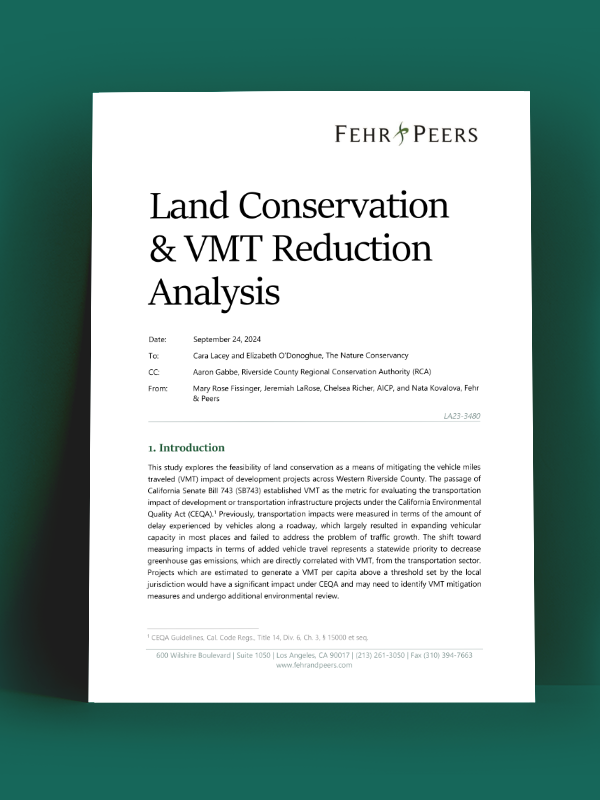
Land Conservation and VMT Reduction Analysis
Policies targeted at reducing Vehicle Miles Traveled (VMT) can be a powerful tool for advancing sustainable land development patterns. Our new white paper explores how VMT mitigation programs could protect biodiversity, preserve critical habitats, and support land conservation.
We recently worked with the Western Riverside County Regional Conservation Authority (RCA) and The Nature Conservancy to explore how VMT credits could be leveraged to fund conservation efforts, aligning transportation and conservation goals. By converting high-VMT parcels into conservation areas and instead encouraging development in lower-VMT areas, this approach helps combat sprawl while achieving long-term environmental benefits.
Read the full white paper to learn more about this innovative strategy, and contact us to explore how it could apply to your projects.
share this article
Contributors

Chelsea Richer
Climate & Resilience Discipline Leader
AICP
Email Me

Mary Rose Fissinger
Senior Engineer/Planner
Email Me

Jeremiah LaRose
Senior Associate
Email Me

Nata Kovalova
Engineer/Planner
Email Me
Explore More

Leveraging Oregon Metro’s TSMO Strategy to Advance Regional Equity
Recipient of a “Diversity, Equity, and Inclusion Award” from the National Operations Center of Excellence, read how Oregon Metro developed a first-of-its-kind transportation systems management and operations (TSMO) strategy that focuses on the importance of evaluating the needs of an entire community.
Quantifying Greenhouse Gas (and VMT) Mitigation Measures
We are excited to share the release of an update to the CAPCOA Quantifying Greenhouse Gas Mitigation Measures. Over the past decade, practitioners have relied heavily on this key reference document for developing VMT and emissions mitigation measures.

Evolving Standard Validation Practices for Traffic Data
In part one of a two-part series on traffic volume estimation and StreetLight validation, we examine key questions to understand the possible variations for two industry standard methods.