
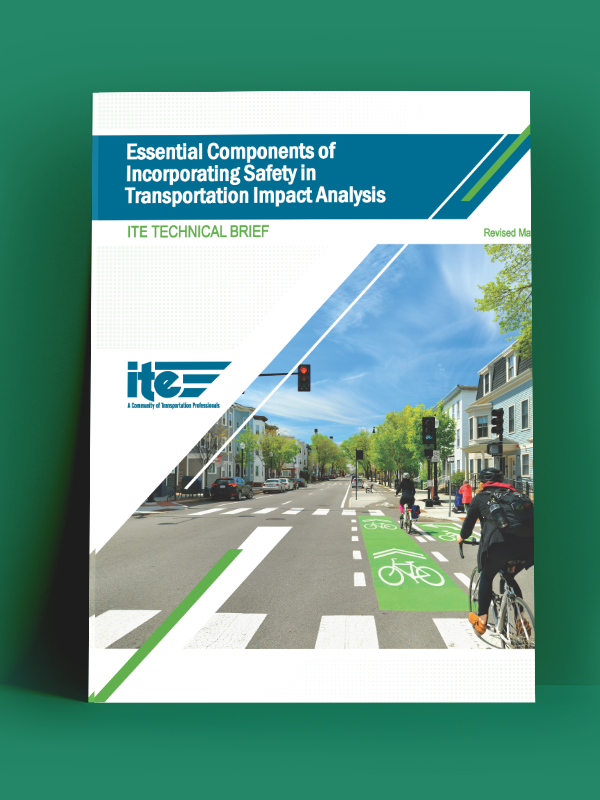
A commitment to Vision Zero requires institutionalizing a new way of thinking about safety, the Safe System approach, into everything we do. As transportation planners and engineers, one of our most frequent project types is a transportation impact assessment for new developments. How do we build land development projects that are not only accessible, but safely accessible, by every mode of transportation?
ITE’s new technical brief Essential Components of Incorporating Safety in Transportation Impact Analysis describes a comprehensive way for public agencies to incorporate the Safe System approach in project reviews. It can help transportation professionals to build proactive, multimodal safety considerations into transportation impact analysis reports. The brief describes eleven core elements with examples of impact methodology and a framework for selecting the methodology best suited for the jurisdiction and project. Mitigations and funding are also discussed, along with links to resources to further explore this topic.
Those who might be interested include:
• Agency practitioners and consultants seeking ways to institutionalize safety and fund safety enhancements, including those looking to implement existing safety plans
• Developers and consultants responding to development guidelines
• Professionals and students learning about impact analysis practices
We are proud to have served as the lead authors of this resource. Contact us to learn more about how Fehr & Peers can help your agency apply this guidance.
share this article
Explore More
SB 743 Agency Decision Matrix
This guide helps California agencies make informed decisions on how to measure and assess Vehicle Miles Traveled (VMT) for land use and transportation projects, ensuring compliance with SB 743.
Still Getting Trip Generation Right: Revalidating MXD+
State-of-the-practice analytical methods should be employed when estimating the trip generation of mixed-use projects. In the latest issue of the American Planning Association’s PAS Memo, John Gard and Corwin Bell of Fehr & Peers describe the advantages, analysis techniques, and use of MXD+ through actual site case studies.

Evolving Visual Communications in a Dynamic World
Partnering with our client, we took on new visual communications strategies through the lens of equitable engagement to elevate participation and build energy around safety improvements.