
Inside Our Summer Intern Program
Inside Our Summer Intern Program
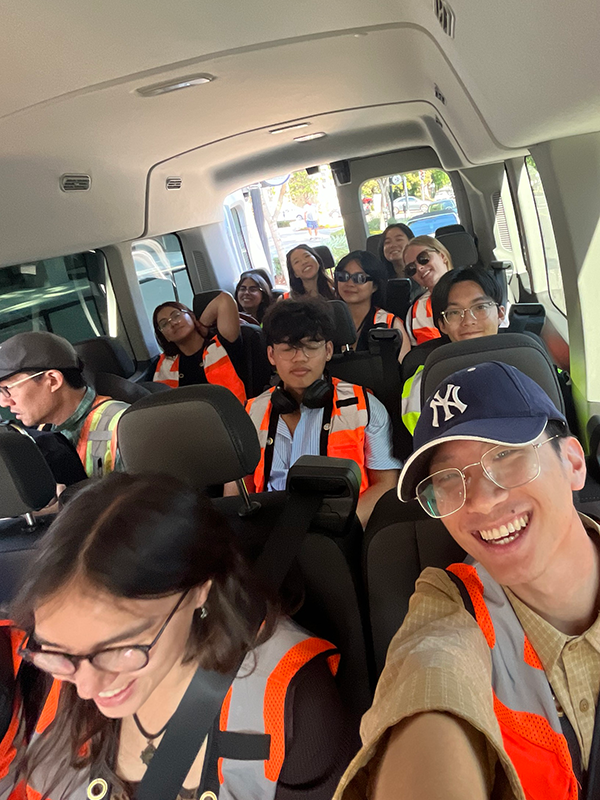
At our company, we’re passionate about transportation and seek like-minded individuals who share our desire to improve the ways people experience transportation across communities. Our internship program is designed to put passion into action from day one. Interns don’t fetch coffee—they dive into impactful projects, collaborating closely with experts in the field.
Here’s a glimpse of the types of projects our interns worked on:
- Active Transportation: Enhancing pedestrian and cycling infrastructure.
- VMT Impacts: Analyzing Vehicle Miles Traveled to reduce environmental footprints.
- Equity in Transportation: Ensuring fair and accessible transportation for all communities.
Collaborative Learning Beyond Our Walls
In addition to our in-house program, this year Fehr & Peers participated in the Environmental, Engineering, and Planning Internship and Charrette (EEPIC) program. EEPIC provides students from underrepresented communities the chance to participate in a two-week charrette focused on an actual project proposed by a local agency. In collaboration with Ascent, Dudek, Environmental Science Associates, PlaceWorks, and Rincon Consultants, Inc., we created opportunities for two of our interns, alongside their interns, to dive into policy, sustainability, design, collaboration, equity, and engagement, shaping the future of Elk Grove, California.
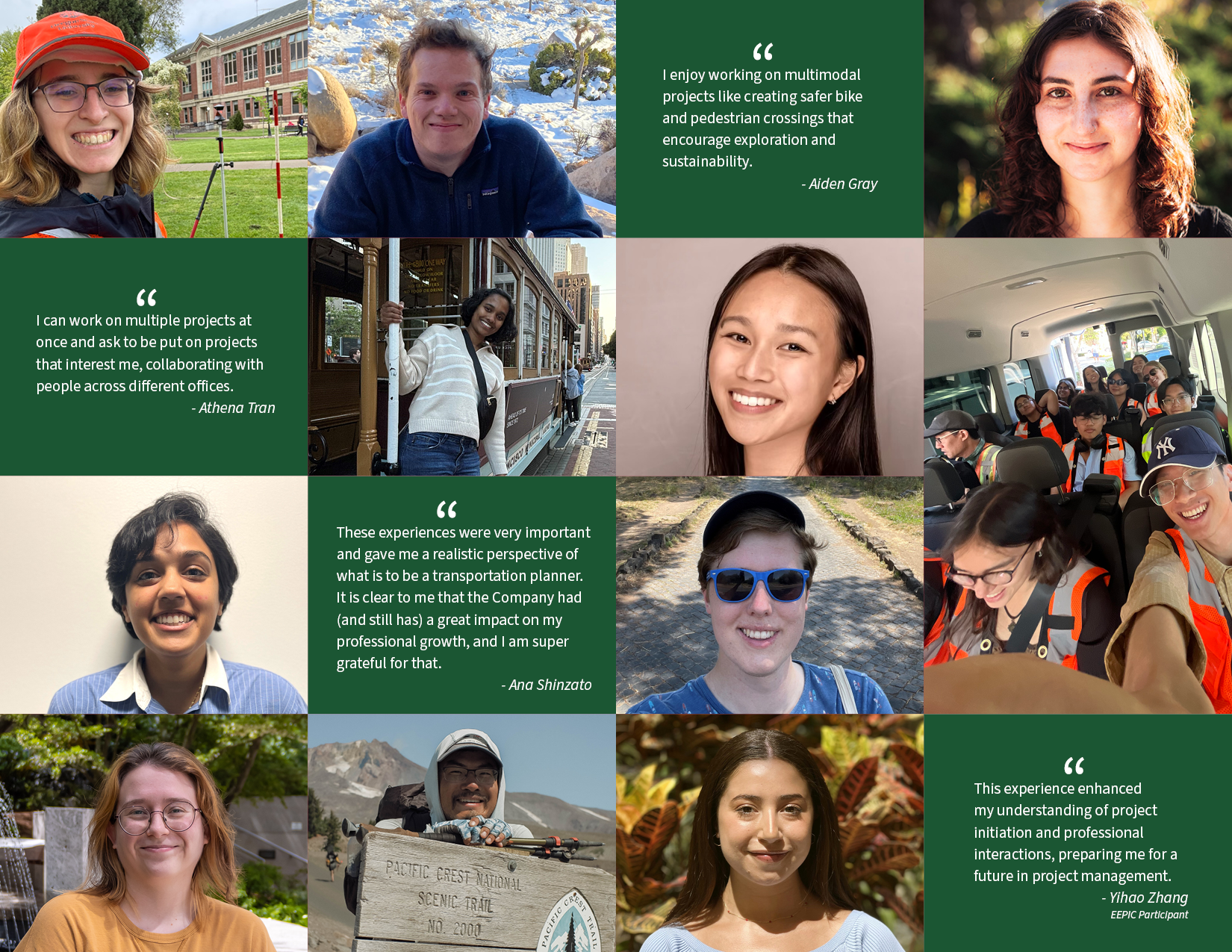
Voices From Our Interns
- Cal Poly, SLO
- California State University, East Bay
- California State University, San Bernardino
- Florida International University
- George Washington University
- Oregon State University
- Rice University
- UC Berkeley
- UC Davis
- UCLA
- UC Irvine
- University of Michigan
- University of Washington, Seattle
- University of North Carolina, Chapel Hill
- Virginia Polytechnic Institute and State University
share this article
Explore More

Leveraging Oregon Metro’s TSMO Strategy to Advance Regional Equity
Recipient of a “Diversity, Equity, and Inclusion Award” from the National Operations Center of Excellence, read how Oregon Metro developed a first-of-its-kind transportation systems management and operations (TSMO) strategy that focuses on the importance of evaluating the needs of an entire community.
Quantifying Greenhouse Gas (and VMT) Mitigation Measures
We are excited to share the release of an update to the CAPCOA Quantifying Greenhouse Gas Mitigation Measures. Over the past decade, practitioners have relied heavily on this key reference document for developing VMT and emissions mitigation measures.

Evolving Standard Validation Practices for Traffic Data
In part one of a two-part series on traffic volume estimation and StreetLight validation, we examine key questions to understand the possible variations for two industry standard methods.