
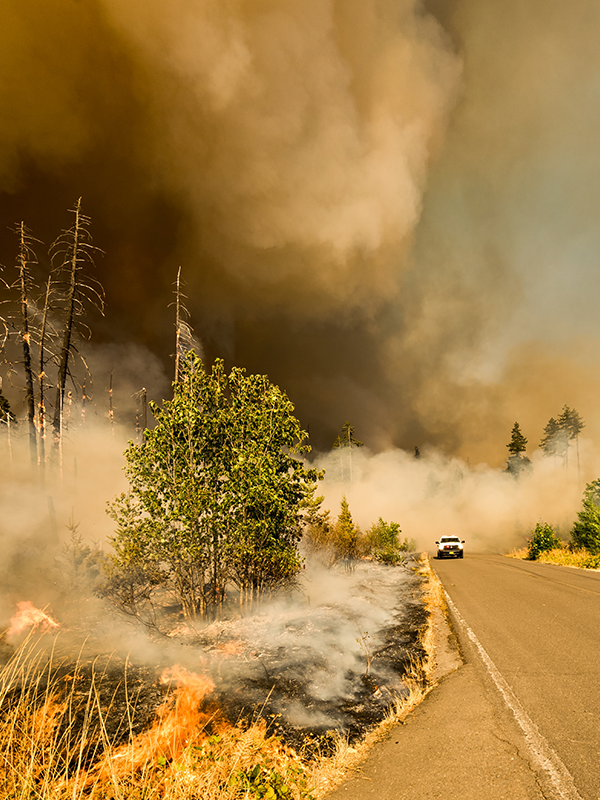
Communities have started to experience an increase in the frequency and severity of emergency evacuations, in part due to the impacts of climate change. As a result, state legislators, including the California Senate and Assembly, have acted by requiring new emergency evacuation analysis in project environmental documents and General Plans. Recent CEQA litigation accompanies state regulations such as SB 99, AB 747, and AB 1409 in underscoring the importance of evacuation analysis.
As experts in climate and resilience within the transportation industry, we offer specialized services to help our clients navigate transportation-related challenges during disruptive events. With a deep understanding of traffic operations and travel demand forecasting, our team uses innovative tools and approaches to help clients address complex emergency evacuation questions. By updating emergency preparedness and communication plans, communities can ensure that residents and visitors are well-informed and equipped to evacuate safely during emergencies.

Evac+ dynamically evaluates evacuation scenarios to provide insights into how many trips are made, where vehicles go, and how long an evacuation trip might take. Interfacing with a regional travel demand model, Evac+ bridges the gap between regional travel models and microscopic traffic simulation models, making it just the right scale for evacuation studies. The tool can help us understand how congestion levels change over time during an evacuation and identify potential problem areas or bottlenecks on a network. Additionally, Evac+ can help identify areas where the development of advanced communication strategies is particularly important.

Resilience+ assesses transportation networks for underlying hazards and appropriate access to city evacuation routes, evacuation centers, and resilience hubs. Resilience+ merges GIS in a workflow that reflects changes in travel routes based on barriers created by natural disasters such as wildfires and flooding. Additionally, it facilitates the development of reliable and accurate communication strategies for emergency needs and evacuations.

TravelAccess+ analyzes and visualizes how much access is provided by each mode of travel to reach destinations of interest within a transportation network. TravelAccess+ considers things such as employment, evacuation areas, medical services, and education, and further incorporates census data to provide a more detailed understanding of how access may vary among different demographic groups and where gaps may exist.
We understand the importance of being ready for anything that comes your way, and we’re committed to supporting our clients and their communities in building their resilience to future emergencies and obstacles. Our primary aim as experts in the field is to ensure that individuals can reach their intended destinations, even in times of crisis. To learn more about applying our tools to your emergency preparedness and communications plans, contact us!
share this article
Contributors

Chelsea Richer
Climate & Resilience Discipline Leader
Email Me

Bob Grandy
San Francisco Market Leader
Email Me

Jason Pack
Orange County Market Leader
Email Me
Explore More

2021 Staff Promotions
As part of the Fehr & Peers culture of empowerment, we congratulate over 130 team members on earning promotions and feature 44 individuals achieving step-level promotions effective July 1.

Safer Today, Stronger Tomorrow
What happens when the safety goals for now and the goals for the future are in conflict? A people-focused Safe System approach considers vulnerabilities today and in the future. Recently adopted as a priority by agencies such as FHWA, Caltrans, the City of Philadelphia, and the Washington State Department of Transportation, safe system is a traffic safety framework emphasizing shared responsibility and a proactive approach where death and serious injury are recognized as unacceptable costs of travel on our roads.

2020 Staff Certifications
With 2020 drawing to a close, we recognize our team’s professional industry achievements amidst the year’s uniquely challenging circumstances.