
A Unified Framework for Roadway Safety
New research connects decades of safety thinking to help transportation professionals prioritize strategies and make more informed decisions.
Every transportation and land use decision has the potential to influence safety, from how we design a street, to where we invest in transit, to which land use policies we put in place—all of which then shape travel choices. But with so many ways to reduce risk, how do we determine where to focus first?
The Safe System Approach has changed how we think about roadway safety, recognizing that people make mistakes, responsibility is shared, and our transportation system should be designed so those mistakes don’t result in death or serious injury. The opportunity now is to put those principles to work in decisions about policies, projects, and investments.
That’s the focus of A Unified Framework for Safe System Implementation, a new paper published in Transportation Research Record.
Connecting What We Know to What We Do
The Unified Framework builds on decades of transportation safety and public health research. Rather than introducing another set of competing principles, it brings established approaches together to clarify what to prioritize, why that order matters, and how strategies can respond to different street contexts.
SEVEN DECADES OF SAFETY THINKING
Each framework offers a different perspective on safety, from understanding injury risk to prioritizing solutions. The Unified Framework connects their strengths to guide implementation. Select each framework to explore its focus.
Tap each framework to explore its focus.
Hover over each framework to explore its focus.
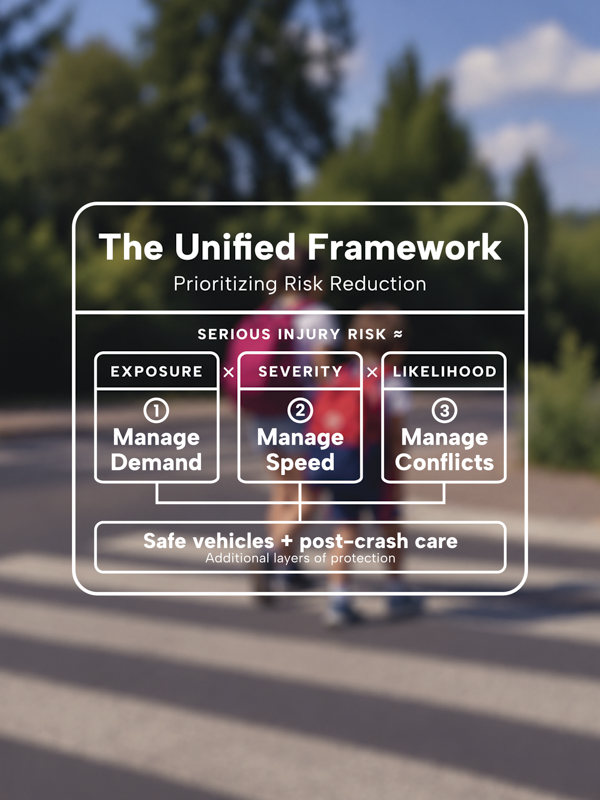
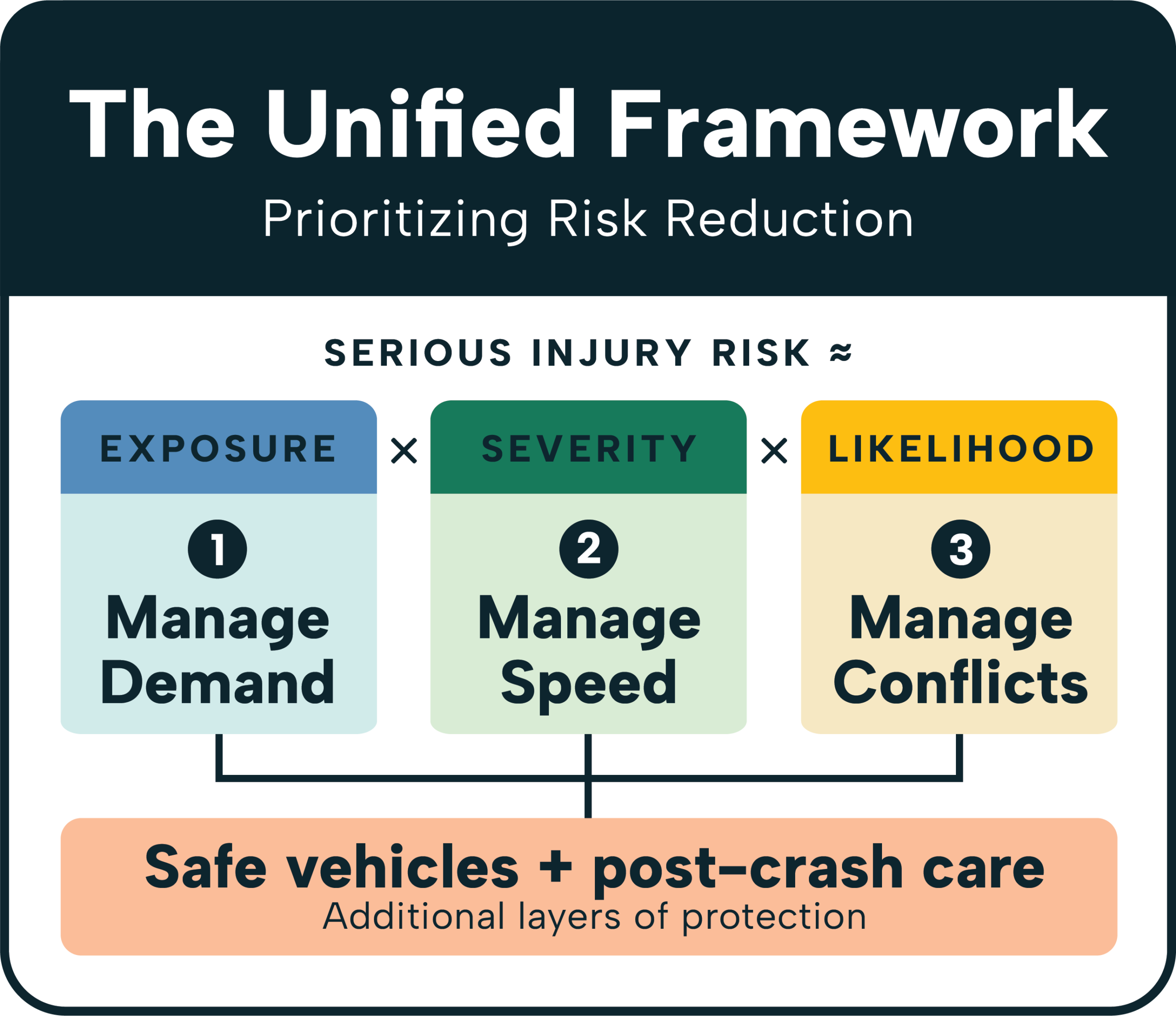
The framework focuses on three interconnected factors that influence serious injury risk, addressed in this order:
1. Exposure: reduce vehicle travel first.
Managing travel demand through land use, transportation options, and network decisions reduces exposure to the kinetic energy of motor vehicles. This helps reduce risk for the most people with the least effort from any one person.
2. Severity: manage speeds next.
Speed shapes how serious injuries are when crashes happen, so lower speeds reduce the harm inflicted on people when a crash occurs.
3. Likelihood: finally, manage conflicts.
Design and operations separate the points where people and vehicles meet in space and time. Reducing vehicle travel and speeds first already makes crashes less likely, and, critically, lowers the complexity and level of protection needed at this step.
Applying the Framework to Better Decisions
What makes the Unified Framework particularly useful is how it connects these priorities to street context.
A local street, a corridor transitioning between different uses, and a roadway focused on moving people and goods may require different strategies. The framework's implementation matrix brings the three risk factors together with these contexts, helping agencies identify appropriate interventions and evaluate how policies and projects influence safety.
It also invites a broader perspective. Rather than looking only at which safety improvements we can add, the framework shines a light on which decisions may be creating risk in the first place, and where our influence is untapped.
From Research to Practice
This thinking also connects to our work on Safety Multipliers, which explores how interventions that address multiple risk factors can reinforce one another.
The Unified Framework gives transportation professionals a way to consider these relationships more systematically. When decisions across planning, policy, design, and operations work together, safety can be built in, not added on.
See the research: Read the full paper, A Unified Framework for Safe System Implementation, in Transportation Research Record.
See the strategies: Explore our Safety Multipliers resource.
share this article
Connect with our Contributors

Meghan Mitman
Principal
AICP, RSP2I
Email Me

Erin Ferguson
Principal
PE, RSP2I
Email Me

Rebecca Sanders
Principal
PhD, RSP2B
Email Me
Explore More

The Impact of Vehicle Electrification on Safety
What impact will the push for more electric vehicles have on road safety? Explore the potential clashes and opportunities in our latest blog.

Investing in Relationships
Investing in and empowering one another is at the core of our mission. Check out reflections from some of our recent mentoring program participants to see how their careers and relationships were impacted.

The Safe System Approach in Local Road Safety Plans
We invite you to explore the new ITE technical brief that provides insights on integrating the Safe System Approach into Local Road Safety Plans while meeting grant requirements and working towards achieving Vision Zero.