
VMT Mitigation Program Implementation Flowcharts
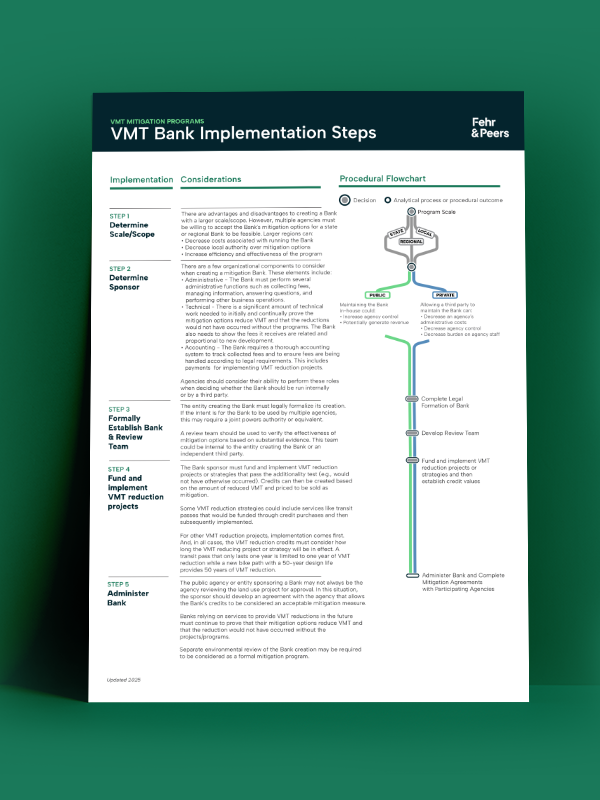
VMT Mitigation Program Implementation Flowcharts
This resource package helps public agencies, regional partners, and development teams compare three common VMT mitigation approaches: VMT Banks, VMT Exchanges, and VMT Impact Fee Programs.
Each flowchart breaks down key steps and considerations, including program scale, sponsorship, mitigation effectiveness, legal formation, nexus requirements, interagency agreements, environmental review, and long-term monitoring. Together, they offer a practical starting point for understanding which approach may fit a community’s needs and what it can take to move from concept to implementation.
These resources may be especially useful when agencies and development teams are exploring clearer, more consistent ways to address VMT impacts while balancing technical, legal, and administrative considerations.
share this article
Explore More

New Office in the Central Valley
Fehr & Peers proudly announces the opening of our Central Valley satellite office! Located in the heart of downtown Stockton, this office will help us continue to provide for and deepen our relationships with current Central Valley clients while further expanding our ability to serve the region.

VMT & GHG Reduction Strategies
Strategies like transit-oriented development, increasing residential density, and improving street connectivity can significantly reduce VMT and GHG emissions, with some measures achieving reductions of up to 31%.

Travel Access as a Key to Equitable Planning
Analyzing travel accessibility measures how well current transportation networks connect us to destinations and exposes potential modal or equity limitations that may be causing difficulties for some users or geographic areas. Learn more and explore our travel access video.