
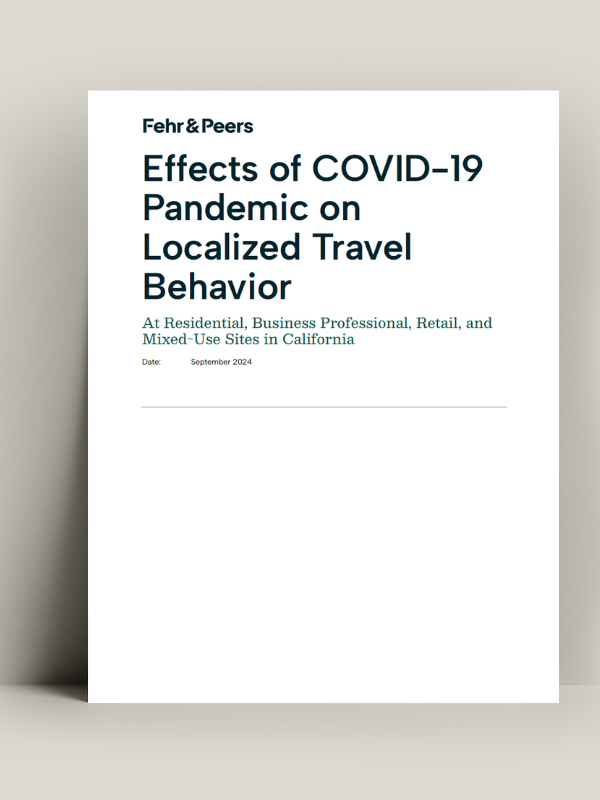
Since the onset of the COVID-19 pandemic, one question we frequently hear from our clients is: How has local travel behavior changed? To help provide answers, we embarked on a self-funded research effort, collecting pre-COVID and 2022/2023 traffic data at residential, retail, and mixed-use sites across California. We also conducted multi-day surveys at large office parks, one of the land uses most affected by the pandemic.
Our findings reveal significant shifts in travel patterns, especially at office buildings, where trip generation rates have dropped well below the rates set by ITE’s 2021 Trip Generation Manual, which consists entirely of pre-COVID data. These insights could have important implications for transportation planning, from travel demand models to infrastructure forecasting and fee programs.
For a deeper look at the data and what it means for future planning, check out our full white paper. Questions? Feel free to reach out to the report’s primary author, John Gard, PE, RSP1.
Contributors

John Gard
Email Me

Brian Wolfe
Email Me
Explore More
Still Getting Trip Generation Right: Revalidating MXD+
State-of-the-practice analytical methods should be employed when estimating the trip generation of mixed-use projects. In the latest issue of the American Planning Association’s PAS Memo, John Gard and Corwin Bell of Fehr & Peers describe the advantages, analysis techniques, and use of MXD+ through actual site case studies.

Evolving Visual Communications in a Dynamic World
Partnering with our client, we took on new visual communications strategies through the lens of equitable engagement to elevate participation and build energy around safety improvements.

Infrastructure Projects & Greenhouse Gas Emissions
Can freeway infrastructure projects have a greenhouse gas emission benefit by improving travel speeds and reducing tailpipe emissions? Explore the corridor level results of three project case studies using different modeling approaches.