
Street Safety in an Autonomous Vehicle Future
Street Safety in an Autonomous Vehicle Future
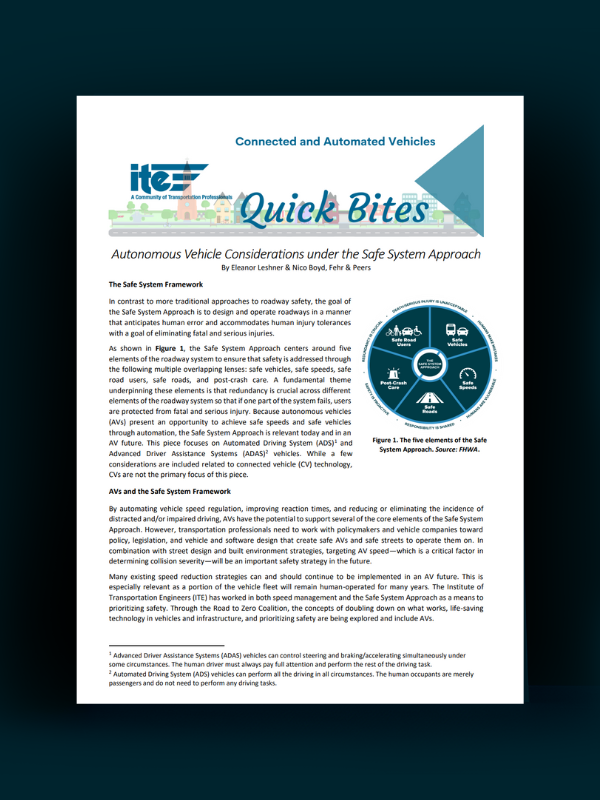
In contrast to more traditional roadway safety approaches, the Safe System approach strives to design and operate our vehicles and infrastructure in a manner that anticipates human error and accommodates human injury tolerances with a goal of eliminating fatal and serious injuries. By automating vehicle speed regulation, improving reaction times, and reducing or eliminating the incidence of distracted and/or impaired driving, autonomous vehicles (AVs) have the potential to support several core elements of the Safe System approach. However, recent trends in traffic-related pedestrian deaths and speeding-related collisions raise increasing concerns and a need for transportation professionals to work with policymakers and vehicle companies toward policy, legislation, and vehicle/software design that create safe AVs—and safe streets to operate them on.
As a direct result of these alarming trends and uncertainty regarding the potential impacts of AVs on safety outcomes, Fehr & Peers partnered with ITE to publish “Autonomous Vehicle Considerations under a Safe System Framework,” which provides a concise summary of potential AV benefits, risks, and other considerations within the Safe System framework. For a more detailed look at street safety considerations for an AV future, we invite you to explore the ITE “Quick Bite.” The article highlights how transportation engineers and planners can design roadways taking “evergreen” safety principles into account, both for today and in the future.
share this article
Explore More
Implementing SB 743 Berkeley Law
This report by Berkeley Law explores how California communities can use Vehicle Miles Traveled (VMT) banking and exchange programs to meet environmental goals under SB 743.
WRCOG SB 743 Implementation Pathway
This document provides guidance for implementing California’s SB 743 in the Western Riverside County area, focusing on using Vehicle Miles Traveled (VMT) as a key metric in transportation impact analysis.

Transportation Impact Analysis: Replacing LOS with VMT
This article discusses California’s shift from using Level of Service (LOS) to Vehicle Miles Traveled (VMT) for evaluating transportation impacts under the California Environmental Quality Act (CEQA), highlighting the implications of Senate Bill 743 (SB 743) for local agencies.