
Street Safety in an Autonomous Vehicle Future
Street Safety in an Autonomous Vehicle Future
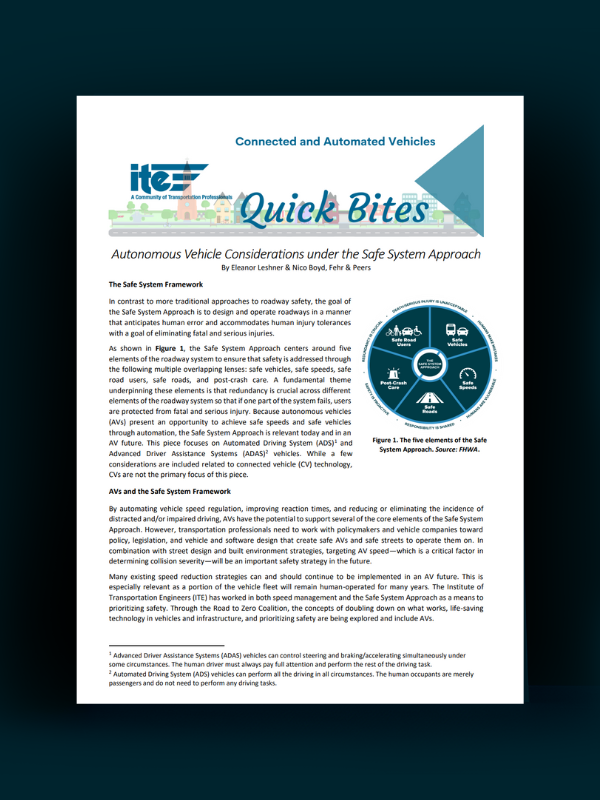
In contrast to more traditional roadway safety approaches, the Safe System approach strives to design and operate our vehicles and infrastructure in a manner that anticipates human error and accommodates human injury tolerances with a goal of eliminating fatal and serious injuries. By automating vehicle speed regulation, improving reaction times, and reducing or eliminating the incidence of distracted and/or impaired driving, autonomous vehicles (AVs) have the potential to support several core elements of the Safe System approach. However, recent trends in traffic-related pedestrian deaths and speeding-related collisions raise increasing concerns and a need for transportation professionals to work with policymakers and vehicle companies toward policy, legislation, and vehicle/software design that create safe AVs—and safe streets to operate them on.
As a direct result of these alarming trends and uncertainty regarding the potential impacts of AVs on safety outcomes, Fehr & Peers partnered with ITE to publish “Autonomous Vehicle Considerations under a Safe System Framework,” which provides a concise summary of potential AV benefits, risks, and other considerations within the Safe System framework. For a more detailed look at street safety considerations for an AV future, we invite you to explore the ITE “Quick Bite.” The article highlights how transportation engineers and planners can design roadways taking “evergreen” safety principles into account, both for today and in the future.
share this article
Explore More
Infrastructure Projects & Greenhouse Gas Emissions
Can freeway infrastructure projects have a greenhouse gas emission benefit by improving travel speeds and reducing tailpipe emissions? Explore the corridor level results of three project case studies using different modeling approaches.

Disruptions in Transportation & Their Unequal Impacts
Increasing numbers of phenomena have disrupted our transportation system recently, and many of them have resulted in inequitable impacts on communities. We explored these dynamics in the realm of transportation equity.

Newly Promoted Firm Principals
Defined by our culture of empowerment and investment in the development of every employee, we are dedicated to career growth, even in uncertain economic times. While we are all navigating challenging circumstances, our firm recognizes that the achievements, dedication, and leadership of our valued team members never diminish. We’re pleased to congratulate our four newly promoted firm Principals.