
Street Safety in an Autonomous Vehicle Future
Street Safety in an Autonomous Vehicle Future
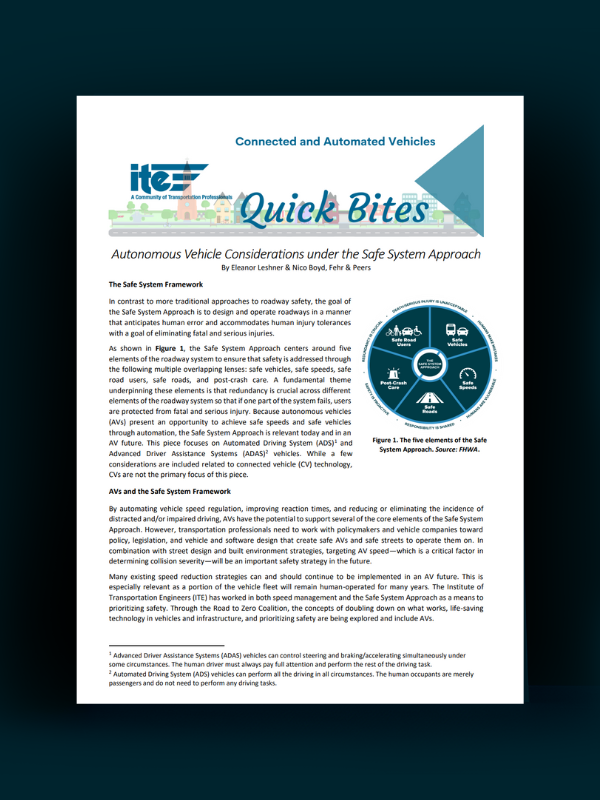
In contrast to more traditional roadway safety approaches, the Safe System approach strives to design and operate our vehicles and infrastructure in a manner that anticipates human error and accommodates human injury tolerances with a goal of eliminating fatal and serious injuries. By automating vehicle speed regulation, improving reaction times, and reducing or eliminating the incidence of distracted and/or impaired driving, autonomous vehicles (AVs) have the potential to support several core elements of the Safe System approach. However, recent trends in traffic-related pedestrian deaths and speeding-related collisions raise increasing concerns and a need for transportation professionals to work with policymakers and vehicle companies toward policy, legislation, and vehicle/software design that create safe AVs—and safe streets to operate them on.
As a direct result of these alarming trends and uncertainty regarding the potential impacts of AVs on safety outcomes, Fehr & Peers partnered with ITE to publish “Autonomous Vehicle Considerations under a Safe System Framework,” which provides a concise summary of potential AV benefits, risks, and other considerations within the Safe System framework. For a more detailed look at street safety considerations for an AV future, we invite you to explore the ITE “Quick Bite.” The article highlights how transportation engineers and planners can design roadways taking “evergreen” safety principles into account, both for today and in the future.
share this article
Explore More

2021 Staff Promotions
As part of the Fehr & Peers culture of empowerment, we congratulate over 130 team members on earning promotions and feature 44 individuals achieving step-level promotions effective July 1.

Safer Today, Stronger Tomorrow
What happens when the safety goals for now and the goals for the future are in conflict? A people-focused Safe System approach considers vulnerabilities today and in the future. Recently adopted as a priority by agencies such as FHWA, Caltrans, the City of Philadelphia, and the Washington State Department of Transportation, safe system is a traffic safety framework emphasizing shared responsibility and a proactive approach where death and serious injury are recognized as unacceptable costs of travel on our roads.

2020 Staff Certifications
With 2020 drawing to a close, we recognize our team’s professional industry achievements amidst the year’s uniquely challenging circumstances.