
The Safe System Approach in Local Road Safety Plans

The Safe System Approach in Local Road Safety Plans
Industry best practices in roadway safety continue to evolve. Vision Zero, the Safe System Approach, Local Road Safety Plans, and now Comprehensive Safety Action Plans (as required by the federal Safe Streets and Roads for All [SS4A] grant program) are all distinct, but related concepts. Local jurisdictions may be finding it difficult to navigate this complex landscape, while meeting funding requirements, and most importantly keeping the focus on improving roadway safety outcomes.

We are pleased to announce the release of a new resource to help roadway safety practitioners, their local partners, and stakeholders understand how each of these pieces of the safety landscape fit together. In this new technical brief Institutionalizing the Safe System Approach in Local Road Safety Plans, local agencies will find a roadmap to help them navigate through the process of incorporating the Safe System Approach into Local Road Safety Plans while meeting SS4A federal grant requirements. The brief describes 16 tenets to help local agencies integrate these concepts and programs, with the goal of achieving Vision Zero.
This resource is especially timely now due to the following factors:
- Local Road Safety Plans are an FHWA Proven Safety Countermeasure
- USDOT has adopted the Safe System Approach as its overarching roadway safety philosophy, and many states are following suit
- The technical brief can serve as a roadmap to the 473 communities that were recently awarded Safe Streets and Roads for All planning grants, and the next round of grant applications
- The US is seeing the highest level of traffic fatalities in 16 years
share this article
Contributors

Emily Finkel
Associate
RSP1
Email Me

Ashlee Takushi
Transportation Planner
RSP1
Email Me

Meghan Mitman
Bay Area Principal-in-Charge
RSP2I
Email Me

Dana Weissman
San Francisco Office Leader
RSP1
Email Me
Explore More

Travel Access as a Key to Equitable Planning
Analyzing travel accessibility measures how well current transportation networks connect us to destinations and exposes potential modal or equity limitations that may be causing difficulties for some users or geographic areas. Learn more and explore our travel access video.
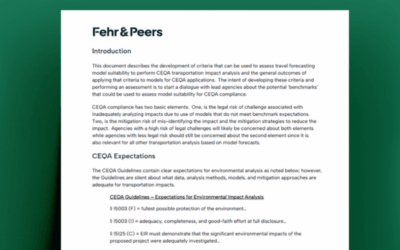
Model Assessment Criteria for CEQA
Agencies should evaluate their models to ensure they provide reliable forecasts and meet CEQA standards for environmental impact analyses.
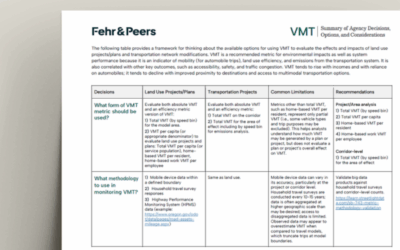
VMT Agency Decision Matrix
This guide helps agencies choose the right methods and tools to measure Vehicle Miles Traveled (VMT) for land use and transportation projects, supporting compliance with California’s SB 743.