
Land Conservation and VMT Reduction Analysis
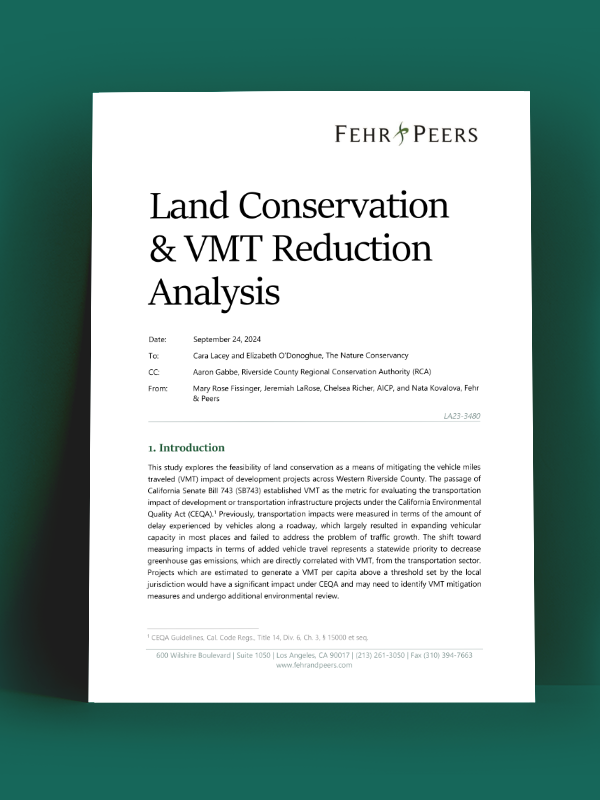
Land Conservation and VMT Reduction Analysis
Policies targeted at reducing Vehicle Miles Traveled (VMT) can be a powerful tool for advancing sustainable land development patterns. Our new white paper explores how VMT mitigation programs could protect biodiversity, preserve critical habitats, and support land conservation.
We recently worked with the Western Riverside County Regional Conservation Authority (RCA) and The Nature Conservancy to explore how VMT credits could be leveraged to fund conservation efforts, aligning transportation and conservation goals. By converting high-VMT parcels into conservation areas and instead encouraging development in lower-VMT areas, this approach helps combat sprawl while achieving long-term environmental benefits.
Read the full white paper to learn more about this innovative strategy, and contact us to explore how it could apply to your projects.
share this article
Contributors

Chelsea Richer
Climate & Resilience Discipline Leader
AICP
Email Me

Mary Rose Fissinger
Senior Engineer/Planner
Email Me

Jeremiah LaRose
Senior Associate
Email Me

Nata Kovalova
Engineer/Planner
Email Me
Explore More
Readiness Planning for Autonomous & Connected Vehicles
Traditional automakers and technology companies continue to test and roll out vehicles that are increasingly capable of “driving themselves” without the aid of a human operator.

A New Narrative for Decision Makers, Seat Utilization: Part 3 of 3
Considering evolving transportation metrics and expanding the range of solutions that can effectively reduce congestion, VMT, and emissions.
Core Elements for Vision Zero Communities
Vision Zero emphasizes a Safe Systems approach, which acknowledges that people make mistakes, and focuses on influencing system-wide practices, policies, and designs to lessen the severity of crashes.