
Land Conservation and VMT Reduction Analysis
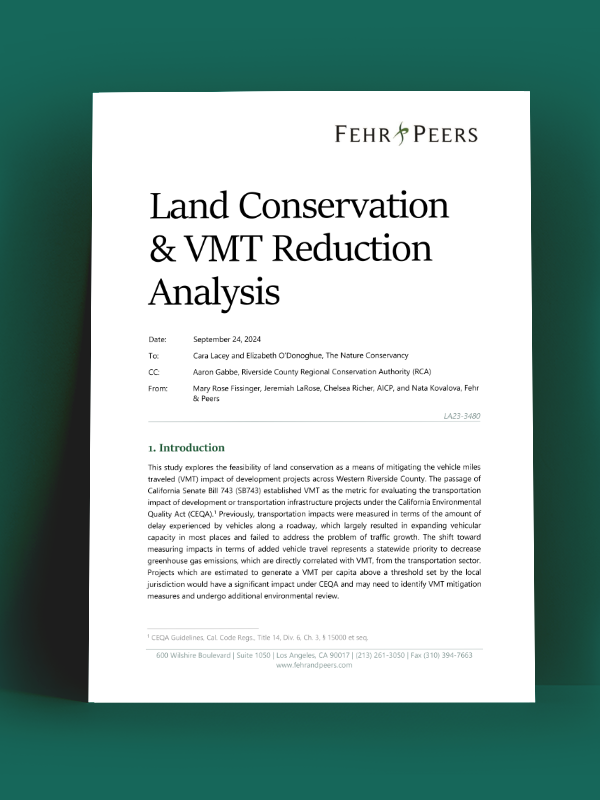
Land Conservation and VMT Reduction Analysis
Policies targeted at reducing Vehicle Miles Traveled (VMT) can be a powerful tool for advancing sustainable land development patterns. Our new white paper explores how VMT mitigation programs could protect biodiversity, preserve critical habitats, and support land conservation.
We recently worked with the Western Riverside County Regional Conservation Authority (RCA) and The Nature Conservancy to explore how VMT credits could be leveraged to fund conservation efforts, aligning transportation and conservation goals. By converting high-VMT parcels into conservation areas and instead encouraging development in lower-VMT areas, this approach helps combat sprawl while achieving long-term environmental benefits.
Read the full white paper to learn more about this innovative strategy, and contact us to explore how it could apply to your projects.
share this article
Contributors

Chelsea Richer
Climate & Resilience Discipline Leader
AICP
Email Me

Mary Rose Fissinger
Senior Engineer/Planner
Email Me

Jeremiah LaRose
Senior Associate
Email Me

Nata Kovalova
Engineer/Planner
Email Me
Explore More

Navigating Long-Term Transit: Planning in an Uncertain Time
We’re partnering with the Whatcom Transportation Authority in Bellingham, Washington to plan the long-term future and develop a strategy for restarting transit service, welcoming back riders, and ensuring riders can safely get where they would like to go. See what’s in the works.

A Transformative Data Collection Solution: Responding with Our Research
We’ve completed an independent, third-party validation review of StreetLight Data’s intersection turning movement volume estimates. See what we found!
VMT Mitigation Through Fees, Banks, and Exchanges
On September 27, 2013, Governor Jerry Brown signed SB 743 into law and started a process intended to fundamentally change transportation impact analysis as part of CEQA compliance. These changes include elimination of auto delay, level of service (LOS), and other similar measures of vehicular capacity or traffic congestion as a basis for determining significant impacts. Instead, transportation impacts will be determined based on changes to vehicle miles of travel (VMT).