
Land Conservation and VMT Reduction Analysis
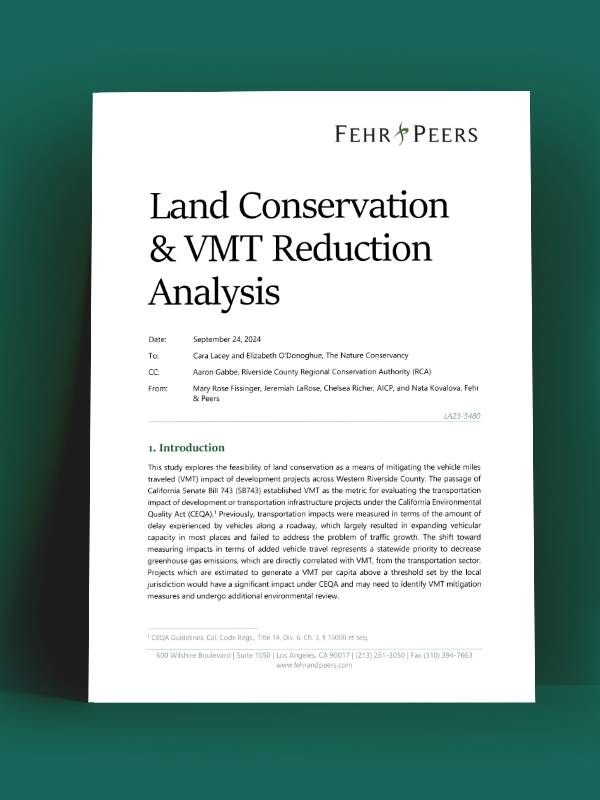
Land Conservation and VMT Reduction Analysis
Policies targeted at reducing Vehicle Miles Traveled (VMT) can be a powerful tool for advancing sustainable land development patterns. Our new white paper explores how VMT mitigation programs could protect biodiversity, preserve critical habitats, and support land conservation.
We recently worked with the Western Riverside County Regional Conservation Authority (RCA) and The Nature Conservancy to explore how VMT credits could be leveraged to fund conservation efforts, aligning transportation and conservation goals. By converting high-VMT parcels into conservation areas and instead encouraging development in lower-VMT areas, this approach helps combat sprawl while achieving long-term environmental benefits.
Read the full white paper to learn more about this innovative strategy, and contact us to explore how it could apply to your projects.
share this article
Contributors

Chelsea Richer
Climate & Resilience Discipline Leader
AICP
Email Me

Mary Rose Fissinger
Senior Engineer/Planner
Email Me

Jeremiah LaRose
Senior Associate
Email Me

Nata Kovalova
Engineer/Planner
Email Me
Explore More

New NCHRP Toolkit Helps Agencies Build Safety Into Everyday Decisions
Making streets safer takes more than individual projects. Our new Safe System approach toolkit, developed through NCHRP Research Report 1181, helps agencies integrate safety into policies, budgets, design standards, and land use decisions. Explore practical tools, real-world case studies, and new IIHS Safe System success stories that show how agencies are turning safety into standard practice.

Announcing Safety Multipliers
What do San Francisco’s Van Ness BRT, New York’s congestion pricing, and Arlington’s intersection program have in common? Each pulls all three Safe System levers at once. We call that pattern a safety multiplier.
Marissa Aho Joins Fehr & Peers
As climate risk reshapes transportation planning, public agencies need strategies that connect resilience with everyday investment decisions. Marissa Aho, FAICP, brings decades of experience helping cities and regions turn climate risk into practical, fundable actions. Learn how her leadership expands our climate adaptation and resilience practice and strengthens the support we provide to communities.