
Land Conservation and VMT Reduction Analysis
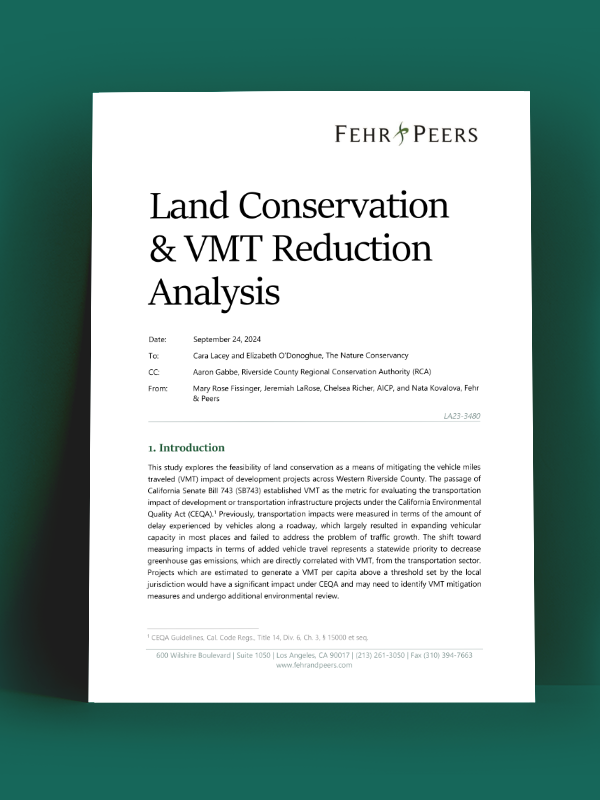
Land Conservation and VMT Reduction Analysis
Policies targeted at reducing Vehicle Miles Traveled (VMT) can be a powerful tool for advancing sustainable land development patterns. Our new white paper explores how VMT mitigation programs could protect biodiversity, preserve critical habitats, and support land conservation.
We recently worked with the Western Riverside County Regional Conservation Authority (RCA) and The Nature Conservancy to explore how VMT credits could be leveraged to fund conservation efforts, aligning transportation and conservation goals. By converting high-VMT parcels into conservation areas and instead encouraging development in lower-VMT areas, this approach helps combat sprawl while achieving long-term environmental benefits.
Read the full white paper to learn more about this innovative strategy, and contact us to explore how it could apply to your projects.
share this article
Contributors

Chelsea Richer
Climate & Resilience Discipline Leader
AICP
Email Me

Mary Rose Fissinger
Senior Engineer/Planner
Email Me

Jeremiah LaRose
Senior Associate
Email Me

Nata Kovalova
Engineer/Planner
Email Me
Explore More
SB 743 White Paper
SB 743 requires evaluating transportation impacts using VMT instead of Level of Service (LOS).

New Office in the Central Valley
Fehr & Peers proudly announces the opening of our Central Valley satellite office! Located in the heart of downtown Stockton, this office will help us continue to provide for and deepen our relationships with current Central Valley clients while further expanding our ability to serve the region.

VMT & GHG Reduction Strategies
Strategies like transit-oriented development, increasing residential density, and improving street connectivity can significantly reduce VMT and GHG emissions, with some measures achieving reductions of up to 31%.