
Evacuation Impact Assessment Checklist
A sharper way to qualitatively analyze evacuation under CEQA
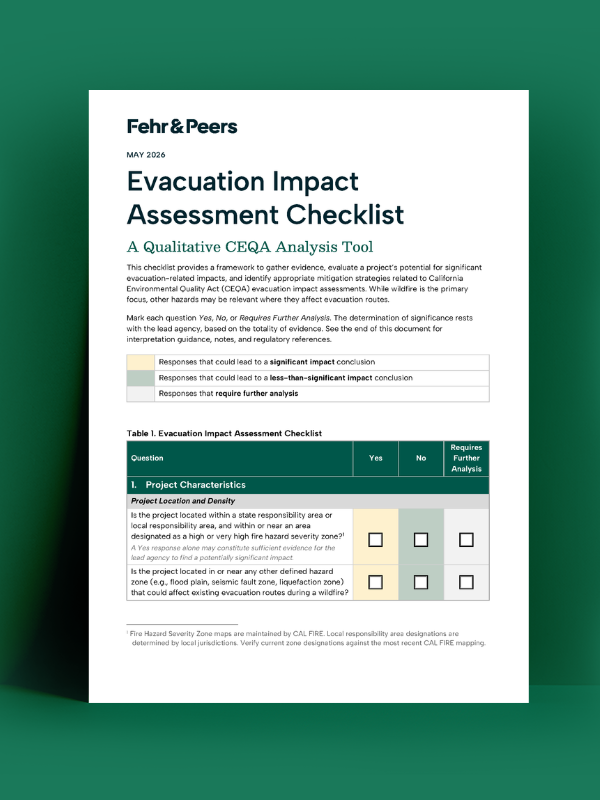
Evacuation Impact Assessment Checklist
A sharper way to qualitatively analyze evacuation under CEQA
When wildfire forces a community to evacuate, decisions made during project review can shape how quickly and safely people can get out. Recent California court decisions have increased scrutiny of how lead agencies address evacuation, and the California State Attorney General’s October 2022 guidance emphasizes evaluating evacuation early, when project design, density, and siting can still change. If you’re scoping a CEQA review today, the expectations are higher than they were a few years ago, and the path to meeting them is not always obvious.
We built the Evacuation Impact Assessment Checklist to help.
The checklist is a qualitative evacuation impact assessment tool that organizes evacuation analysis into three categories: project characteristics that may affect wildfire risk or evacuation capacity, including social vulnerability factors that can affect how people receive and act on warnings; the project and jurisdiction’s emergency access, egress, and evacuation preparedness; and the project’s potential impact on evacuation for the existing community. Questions are drawn from the CEQA statute, the Attorney General’s guidance, and recent court decisions. Wildfire is the primary focus, but the checklist can also be applied to other hazards that affect evacuation routes.
Used early, the checklist provides a clearer structure for documenting evidence, identifying where more information is needed, and determining whether additional analysis may be warranted.
share this article
Connect with our Contributors

Ron Milam
Director of Evolving the Status Quo
Email Me

Chelsea Richer
Climate & Resilience Discipline Leader
Email Me

Ian Barnes
Principal
Email Me


Explore More
Metro Emerging Trends Study
Utilizing the TrendLab+ scenario planning tool, the study assesses the short- and long-term impacts of these trends on vehicle miles traveled (VMT), transit usage, safety, and equity within the Portland region, providing insights to inform the 2023 Regional Transportation Plan update.

Applications of Big Data in Safety Analysis
Check out the new ITE brief written for transportation professionals to determine the most effective data sources to apply when scoping, implementing, and evaluating safety projects.

Reclaiming a Concrete Desert
Learn how the once-touted largest single surface parking lot, now known as SDSU Mission Valley, is being reimagined. The new design is all about reducing the need for cars, improving mobility, and creating a vibrant, walkable, and bikeable environment for the local community to enjoy.