
What Is Downtown DC For?
The decongestion pricing debate is really a question about recovery, access, and what the city wants to become.
A perspective from Eric Womeldorff, Principal and Transportation Economics Practice Leader, Fehr & Peers Washington, DC

What Is Downtown DC For?
The decongestion pricing debate is really a question about recovery, access, and what the city wants to become.
A perspective from Eric Womeldorff, Principal and Transportation Economics Practice Leader, Fehr & Peers Washington, DC
Washington, DC is debating congestion pricing at a moment when downtown is still being redefined. The recently released decongestion pricing study has added new fuel to that conversation, but it has not resolved the harder question underneath it: what problem is the city actually trying to solve?
That is the focus of Eric Womeldorff’s brief. Rather than argue for or against pricing, he examines why this debate has become so difficult to settle and why the answer depends on how the city sees downtown’s future.
A few reasons this perspective is worth reading:
The status quo is not neutral.
Even without a formal charge, access to downtown already comes with costs in delay, frustration, and unreliable travel.
The study was built for a different city.
By the time it was released, commuting patterns, office demand, and the federal footprint had all shifted in meaningful ways.
The real disagreement is bigger than traffic.
The question is not only whether pricing would reduce congestion. It is also whether this is the right moment to manage downtown access differently while recovery is still uneven.
Eric has spent his career working at the intersection of land use, travel behavior, and transportation economics in some of the country’s most complex urban environments. He welcomes the conversation.
share this article
Contributor

Eric Womeldorff
Principal
Email Me
Explore More

Driving Less Starts with Building Differently
How much can planning decisions actually reduce driving? Our latest research introduces a statistical model that links built environment choices—such as density, transit service, walkability, and land use mix—to vehicle miles traveled (VMT). The findings give planners and policymakers practical, evidence-based tools to evaluate scenarios, understand tradeoffs, and make more informed transportation and land use decisions.
Navigating VMT Under CEQA
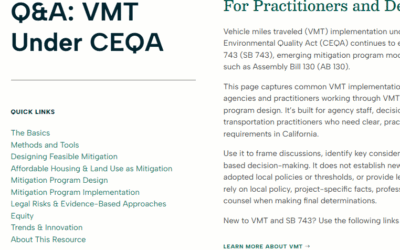
VMT under CEQA continues to evolve as agencies, practitioners, and decision makers work through analysis methods, mitigation feasibility, and defensible evidence. Our new Q&A resource offers practical answers on vehicle miles traveled, SB 743, mitigation program design, implementation, administration, and legal and strategic considerations.
Demand Management Is Injury Prevention
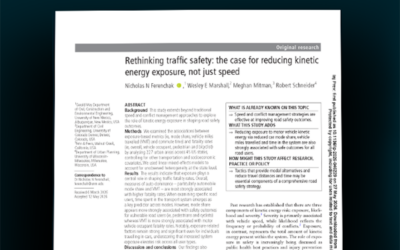
New research shows that reducing driving exposure may be one of the most powerful safety strategies available. The findings connect VMT, mode share, and travel time to fatality rates, reframing demand management as injury prevention.