
Encouraging Resiliency During Evacuations

Encouraging Resiliency During Evacuations
In the face of increasing natural disasters and disruptions related to climate change, many cities and counties are thinking about their transportation networks with a greater focus on creating access and moving people safely in an emergency.
City roadways are typically sized based on the traffic generated during an average weekday, a common practice known as the 30th highest hour. When considering evacuations, however, cities and counties need to think differently. As related legislative requirements grow, many developers must also consider evacuation analysis for new developments.
How will people travel during an evacuation?
What routes will they take?
How will evacuations interact with other travel that is occurring in and around evacuating areas?
Understanding Evacuation Travel
Fehr & Peers recently partnered with the City of Rancho Cucamonga as they were preparing to update their General Plan. The city has a lot in common with many California cities when it comes to the hazard risks they face: high fire danger, potential flooding, and active fault lines.
As a follow-up to the expansive and proactive Resilient IE effort completed by Western Riverside Council of Governments, city officials in Rancho Cucamonga wanted to better understand how their transportation system could be augmented to help with egress in the event of a disaster. But how?
Evacuations cause extreme travel behavior that traditional assessments are not entirely equipped to evaluate. Their unpredictability in terms of scope and speed make it impossible to replicate real-life scenarios. To best inform decision makers, residents, and policy, Rancho Cucamonga needed a finer-grained solution to see where people might be in the event of a disaster and the demand this would create on the transportation system at any point, day, or night.
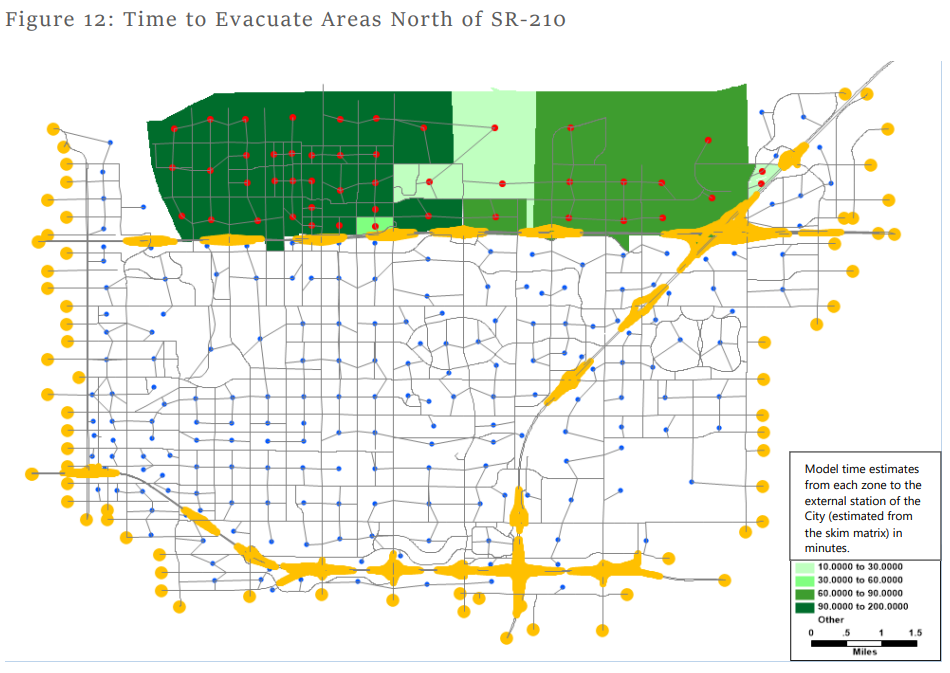
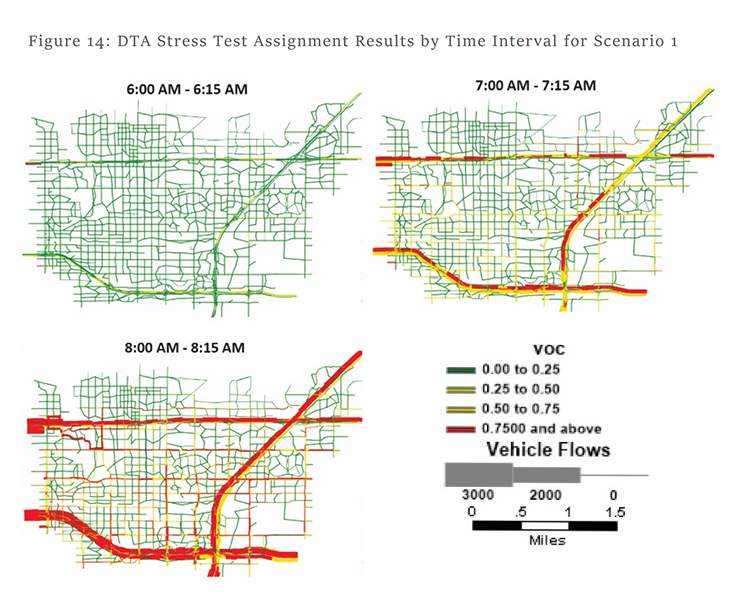
In partnership with the city, we developed and customized a new tool, Evac+, that integrates with travel demand models to provide a dynamic look at the most vulnerable areas furthest from evacuation centers or options to exit the city. It also reveals differences in the time it would take to evacuate, under current conditions, and in different disaster scenarios.
With a greater understanding of how travel interacts with background traffic, the city was able to create an Evacuation Assessment that shows which roadway investments would help the entire network during an evacuation event, improving circulation and connectivity to areas that are more isolated.
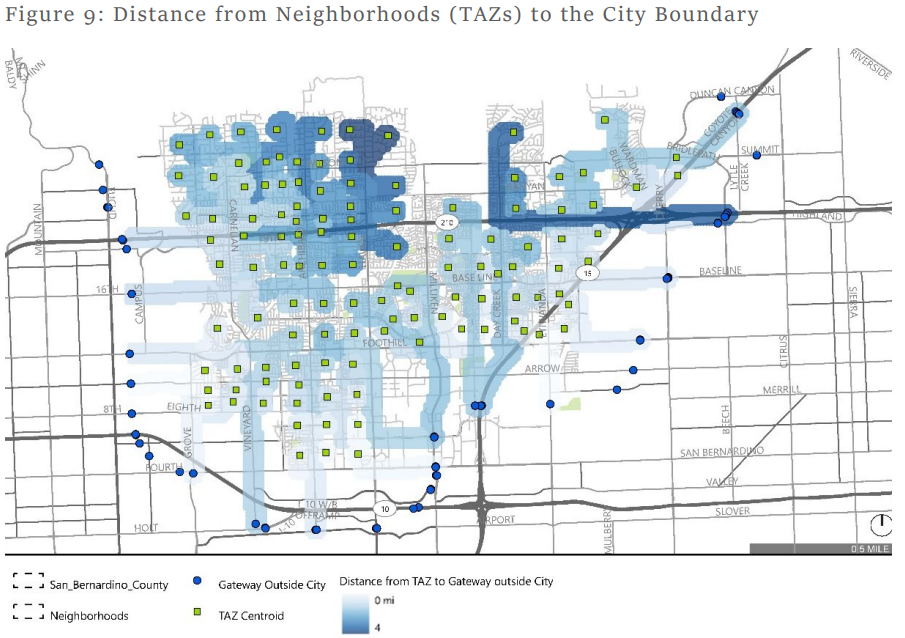
Pulled from the Evacuation Assessment, the following show the distance from various neighborhoods to the city boundary, along with two outputs from the Evac+ tool, illustrating the time evacuate specified areas and a route stress test by time for a proposed evacuation scenario.
As recent natural disasters have proven year after year, the worst time to update an emergency plan is during an emergency evacuation. Though the hope is that these plans never have to be tested, defining key exit points and identifying potential problem areas early on can help the members of a community feel more prepared and resilient in the event of a disaster.
Interested in learning more about this study or customizing Evac+ for emergency planning in your community?
share this article
Explore More
Prioritizing People in Multimodal Design
Discover how one city is redesigning their streets to make experiencing destinations safer and more enjoyable, and how their process and design typology can be adapted to streets across the US.
Quantifying VMT Reduction
How can transportation agencies reduce overall vehicle miles traveled and still generate revenue? In a recent study, we evaluated the impact of making transit free of charge compared to implementing a VMT tax and whether the costs for travelers is equitable.
Achieving Freight Greenhouse Gas Goals
Available guidance for agencies to gather an accurate picture of current freight activity is limited. Check out how this community defined their baseline in four steps to be able to evaluate freight zero emission zones as a strategy for meeting new climate and environmental policy goals.