
MXD Trip Generation Model
A Tool for Estimating Trip Generation for Mixed-Use Developments
Conventional trip generation methods often overestimate vehicle traffic for mixed-use developments. Many commonly applied Institute of Transportation Engineers (ITE) trip generation rates come from single-use suburban locations that are designed for driving, with limited transit access and walkability. Methods used to adjust those rates are also based on a small number of observations that are more than 20 years old and do not reflect current travel characteristics.
Our MXD tool was built to address these limitations, providing more accurate trip estimates for mixed-use developments and mixed-use neighborhoods with strong connectivity, walkability, and transit service.


Why Use MXD
MXD performs more consistently than other methods and better reflects how people are traveling today in mixed-use settings.
Built on ITE Methods
MXD builds on conventional ITE trip generation by factoring in research on built environment “D” variables, like density, diversity of land use, and design/connectivity, to better reflect how context changes travel behavior. The latest version of MXD incorporates ITE 12th Edition trip generation rates as its foundation.
Customizable for Your Community
Based on 622 mixed-use sites across over 30 metro areas nationwide, MXD was developed to be used anywhere in the United States. For communities with unique development patterns or transportation systems, MXD can be calibrated using local land use, transit, and street network data to better reflect specific local conditions.
Validated Against Current Conditions
MXD was checked and calibrated against observed post-COVID (2025) trip counts at over 25 mixed-use sites across the country, giving agencies and practitioners more confidence in the results.
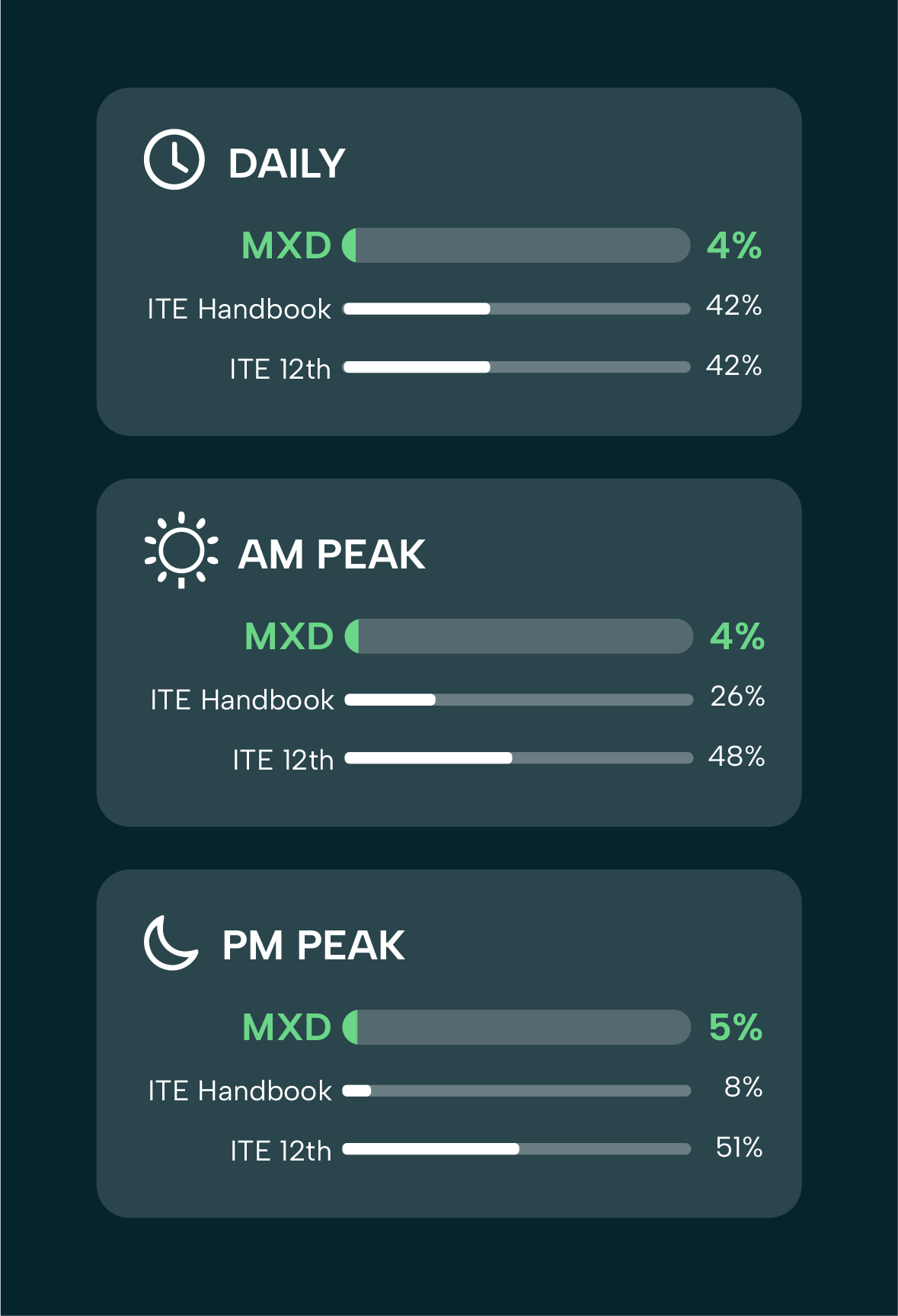
NATIONALLY VALIDATED
MXD has the lowest mean error.

NATIONALLY VALIDATED
MXD has the lowest mean error.
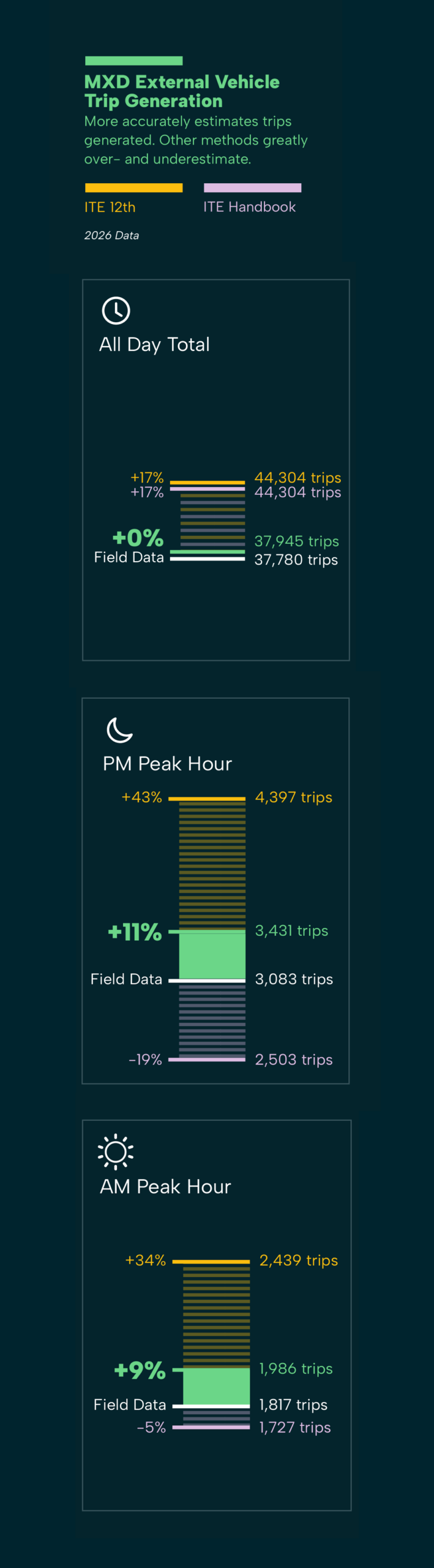
A GEORGIA CASE STUDY
MXD was the most consistent across all time periods.
Results from Avalon Town Center in Alpharetta, Georgia show that MXD estimates were closer to trips measured in the field than other available methods. In contrast, other methods sometimes substantially overestimated trips and, in other periods, underestimated them. The chart below compares each method’s estimates to the field counts, shown as percent differences from the observed trips.

Interested in applying MXD for your community or project? We can develop locally calibrated tools that support more accurate and context-sensitive transportation analysis.
Let’s Connect


Mackenzie Watten
Travel Behavior Practice Leader

Gillian Zhao
Planner
